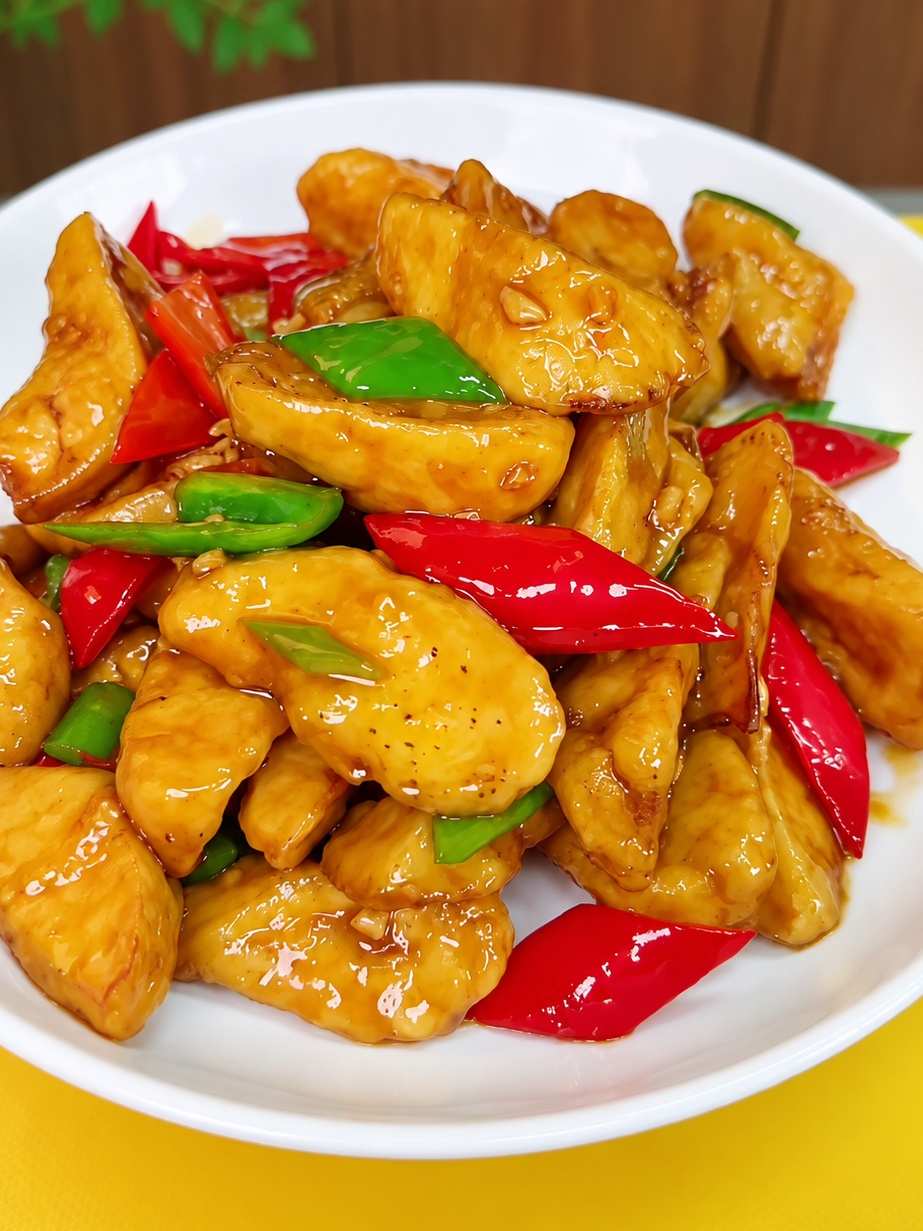
When I make Chinese red-braised eggplant at home, I first cut the eggplant into angled pieces and soak them in water for 3 minutes. I then coat the pieces with cornstarch in several batches before frying them in hot oil.
After frying, I quickly toss the eggplant with a sauce that I prepared in advance. The outside develops a golden coating, while the inside remains soft.
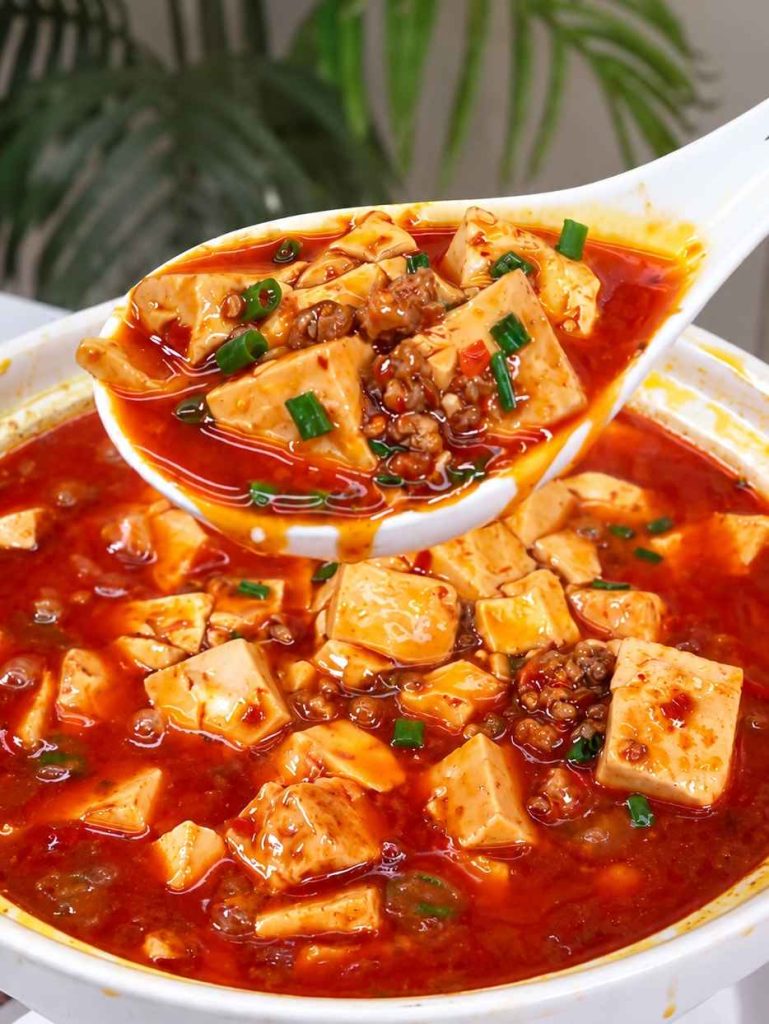
Red-braising is a cooking method that uses soy sauce and other seasonings to add color and flavor to food. Liquid is added during cooking. Near the end, some of the liquid evaporates, allowing the sauce to thicken and cling to the ingredients. For another saucy Chinese dish, try our homemade Mapo tofu recipe.
The main goal of this recipe is to create an even cornstarch coating, fry the eggplant at a suitable temperature, and finish by tossing it quickly in a thick, savory sauce. By controlling these steps, I can make homemade red-braised eggplant with a lightly crisp, browned exterior, a soft interior, and an even coating of sauce. For another vegetable side with a savory, aromatic finish, try our dry-fried green beans.
This homemade Chinese red-braised eggplant recipe serves 2 to 3 people. Preparation takes approximately 15 minutes, soaking takes 3 minutes, and cooking takes approximately 20 minutes. The total time is about 38 minutes.
Chinese Red-Braised Eggplant
Ingredients
Equipment
Method
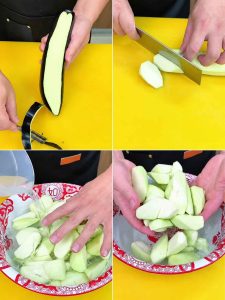
- Wash 500 g of eggplant and remove the skin with a vegetable peeler.
- Cut the eggplant into pieces approximately 3 cm across using the rolling-cut method. After each cut, rotate the eggplant before making the next cut. This creates pieces with angled surfaces.
- Place the eggplant in a large bowl and add 1,500 ml of water. Soak for 3 minutes.
- Remove the eggplant from the water and drain for 2 minutes. Gently pat the surface with kitchen paper towels until there are no visible water droplets, while keeping the surface slightly moist.
- Cut 50 g of red pepper and 50 g of green pepper into pieces approximately 2 cm across.
- Wash and dry 10 g of scallions. Cut 2 g into small pieces to help estimate the oil temperature. Cut the remaining 8 g into pieces approximately 3 cm long for the final stir-fry.
- In a small bowl, combine 120 ml of water, 15 ml of light soy sauce, 5 ml of dark soy sauce, 10 g of oyster sauce, 5 g of white sugar, 1 g of salt, and 5 g of cornstarch.
- Stir the sauce thoroughly until the sugar and salt dissolve and no obvious cornstarch lumps remain at the bottom. Stir again immediately before pouring the sauce into the pan.
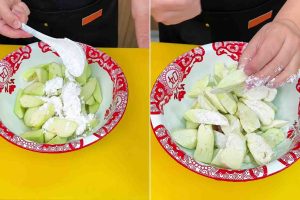
- Place the drained eggplant in a clean, large bowl.
- Add 20 g of cornstarch and gently toss the eggplant so that the starch contacts all sides of the pieces.
- Add 10 ml of water and toss again.
- Add the second 20 g portion of cornstarch and toss. Finally, add the remaining 20 g of cornstarch and mix thoroughly.
- Check the coating. Each eggplant piece should have a thin, even layer of cornstarch. There should not be large amounts of dry starch or thick, wet clumps.
- Pour 1,000 ml of cooking oil into a deep pot approximately 20 cm in diameter and at least 8 cm deep. The oil must not fill more than half the pot's depth.
- Use a kitchen thermometer to heat the oil to 160°C before frying. Try to maintain the oil temperature between 160°C and 175°C during frying.
- If you do not have a thermometer, place a 2 g piece of dry scallion in the oil and observe it. Continuous small bubbles around the scallion can provide a rough indication that the oil is hot enough. Remove the scallion after checking. This method is less accurate than using a thermometer.
- Divide the 500 g of eggplant into 3 batches, approximately 165–170 g per batch. Do not add all the eggplant at once, because too much food can lower the oil temperature.
- After adding each batch, leave the eggplant undisturbed for 30 seconds. Do not stir immediately. Once the starch coating begins to set, gently separate any pieces that are sticking together with a metal slotted spoon.
- Continue frying for 4–5 minutes while maintaining the oil temperature between 160°C and 175°C. Remove the eggplant when the surface is light golden, the coating has set, and the inside has softened. Allow excess oil to drain.
- After frying each batch, wait for the oil temperature to return to approximately 160°C before adding the next batch.
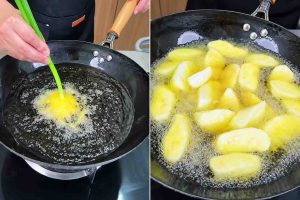
- Add 10 ml of cooking oil to a wok or heavy-bottomed frying pan at least 28 cm in diameter. Heat over medium-high heat.
- Add the remaining 8 g of scallions and stir-fry for approximately 20 seconds.
- Add 50 g of red pepper and 50 g of green pepper. Continue stir-frying for approximately 1 minute.
- Stir the prepared sauce again, then pour it into the pan. Heat for 30–60 seconds while stirring continuously, until the sauce visibly thickens.
- Return all the fried eggplant to the pan. Toss quickly for 30–45 seconds until the sauce evenly coats the eggplant pieces.
- Turn off the heat immediately and transfer the dish to a serving plate. Serve promptly to reduce the amount of moisture absorbed by the crispy coating.
Notes
- The eggplant should not have visible water droplets before frying. Water entering hot oil can cause splattering.
- The oil must not fill more than half the pot’s depth. Never use water to extinguish an oil fire.
- If only regular soy sauce is available and light soy sauce, dark soy sauce, and oyster sauce are unavailable, use 20 ml of regular soy sauce, 120 ml of water, 5 g of sugar, 0.5 g of salt, and 5 g of cornstarch. The sauce will have a lighter color and less oyster-derived flavor.
- If dark soy sauce is unavailable, omit it. The finished dish will have a lighter color.
- Red pepper and green pepper can each be replaced with the same weight of red bell pepper and green bell pepper, respectively. The dish will be less spicy and taste sweeter.
- Cornstarch can be replaced with the same weight of potato starch, but the coating texture and hardness after cooling may differ.
- Finish stir-frying the eggplant as soon as possible after frying. The longer the sauce remains in contact with the coating, the more moisture the coating may absorb and the softer it may become.
Tips for Making Chinese Red-Braised Eggplant More Consistently
1. Do Not Leave Too Much Water on the Eggplant
Drain the eggplant thoroughly before frying. Visible water droplets can cause hot oil to splatter. Excess moisture can also prevent the cornstarch coating from forming evenly.
2. Both Low and High Oil Temperatures Can Affect the Texture
When the oil temperature is too low, the eggplant may take longer to develop a crisp outer layer. It may also absorb more oil. When the oil temperature is too high, the outside may brown too quickly while the inside remains too firm.
I recommend using a kitchen thermometer to keep the oil temperature between 160°C and 175°C. This makes the frying process easier to control than relying on the heat setting alone.
3. Let the Coating Set Before Moving the Eggplant
When the eggplant first enters the hot oil, the cornstarch coating has not fully set. Leave the eggplant undisturbed for 30 seconds before gently separating the pieces.
This helps prevent the coating from falling off and reduces the chance of the eggplant pieces sticking together.
4. Do Not Simmer the Sauce for Too Long
After heating the sauce for 30 to 60 seconds, you should usually see it begin to thicken noticeably. After adding the fried eggplant, toss everything together for another 30 to 45 seconds.
If you continue simmering the eggplant for too long, the cornstarch coating will gradually absorb moisture from the sauce. The outer layer will then become softer.
5. Handle Hot Oil Safely
When deep-frying eggplant, do not fill the pot more than halfway with oil. Never put ingredients with large amounts of surface water directly into hot oil.
Never use water to extinguish a cooking oil fire. If it is safe to do so, turn off the heat first. Then cover the fire with a suitable metal lid or use an appropriate fire extinguisher. Do not attempt to move the burning pot.
6. Adjust the Seasoning Based on the Saltiness of the Soy Sauce and Oyster Sauce
Different brands of soy sauce and oyster sauce can have different salt levels. I recommend following the recipe measurements the first time you make this dish.
If you use regular soy sauce instead of Chinese light soy sauce, follow the substitution measurements provided earlier. This helps prevent the finished sauce from becoming too salty.