Chinese Eggplant and Yardlong Bean Stir-Fry (Qie Zi Shao Dou Jiao) is a classic Chinese home-style vegetable dish featuring two simple ingredients with very different textures. The eggplant becomes soft and tender after steaming, while the yardlong beans retain a pleasant bite. Garlic, fresh red chili, and a savory sauce bring everything together, coating the vegetables with layers of rich, well-balanced flavor.
One detail that makes this version different is the cooking method. Instead of deep-frying the eggplant and beans, both vegetables are steamed first and then quickly stir-fried. This approach allows the eggplant to develop a soft texture without requiring a large amount of cooking oil. A final round of high-heat stir-frying helps remove excess moisture and allows the sauce to cling to the vegetables.
It is also a practical way to prepare a satisfying Chinese vegetable dish using ingredients that are relatively easy to find in most supermarkets or Asian grocery stores.
For another simple way to prepare the same vegetable, try our stir-fried yardlong beans with garlic and red bell pepper.
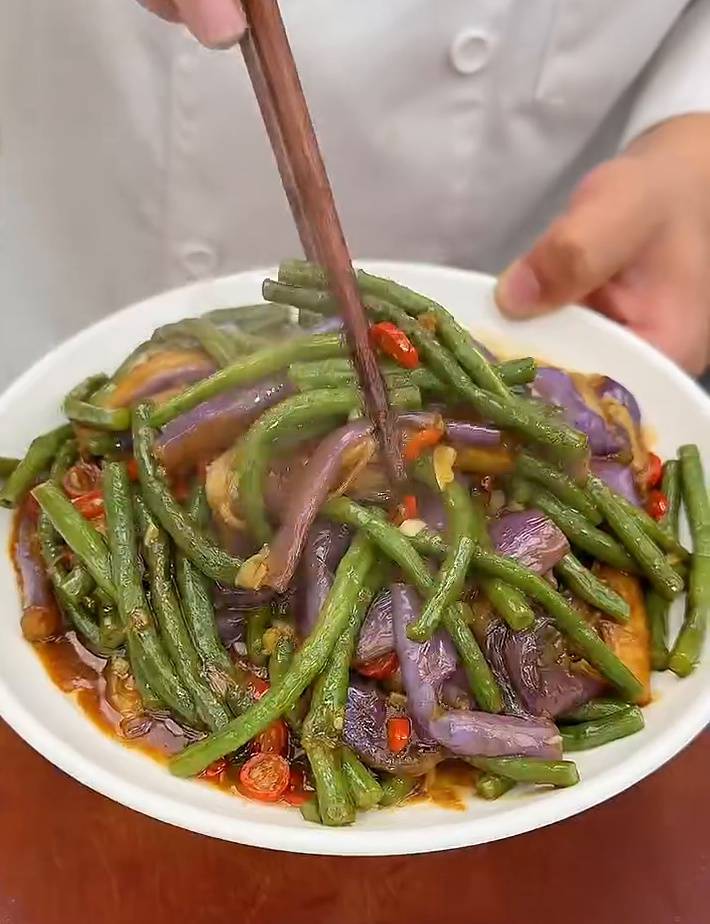
茄子烧豆角(Qie Zi Shao Dou Jiao,Chinese Eggplant and Yardlong Bean Stir-Fry)
Ingredients
Equipment
Method
- Wash the eggplants and yardlong beans thoroughly under running water. Trim both ends of the beans and break them into manageable sections.
- Cut the eggplants into large sections approximately 6 to 7 cm long. There is no need to peel them.
- Peel and finely mince the garlic. Thinly slice the fresh red chili and set both aside.
- Pour approximately 1.5 liters of water into the steamer and bring it to a full boil over high heat.
- Arrange the eggplant and yardlong beans in the steamer basket. Lightly drizzle or spray the vegetables with 5 ml of neutral cooking oil.
- Cover and steam over medium-high heat for approximately 10 minutes. Start timing once the vegetables are placed over the boiling water.
- Check the vegetables. The eggplant should be soft, and the yardlong beans must be thoroughly cooked. If the beans are still firm, continue steaming for a few additional minutes.
- Remove the vegetables from the steamer and allow them to cool naturally until they are comfortable to handle. Do not immediately soak them in cold water.
- Use your hands to tear the eggplant lengthwise into relatively wide strips. Do not tear it too finely. Keep the beans in their original shape or adjust their length as needed.
- In a small mixing bowl, combine 30 ml of light soy sauce, 7.5 ml of dark soy sauce, 15 g of oyster sauce, 6 g of white sugar, 1 g of salt, and 0.5 g of ground white pepper.
- Add 45 ml of water and 5 ml of sesame oil.
- Add 5 g of potato starch and stir thoroughly until all the ingredients are evenly combined and no visible starch lumps remain.
- Stir the sauce again immediately before using because the potato starch can settle at the bottom of the bowl.
- Heat a wok over medium heat and add the remaining 15 ml of neutral cooking oil.
- Add the minced garlic and sliced red chili. Reduce the heat to low and stir-fry for approximately 20 to 30 seconds, until fragrant. Be careful not to burn the garlic.
- Add the steamed yardlong beans and torn eggplant to the wok.
- Increase the heat to high and stir-fry gently for approximately 1 to 2 minutes. This helps remove excess surface moisture and distributes the garlic and chili aroma.
- Stir the prepared seasoning sauce again, then pour it evenly over the vegetables.
- Continue tossing gently over high heat for approximately 1 to 2 minutes, allowing the sauce to coat the eggplant and beans evenly.
- Watch for the sauce to become slightly thickened and glossy, forming a light coating around the vegetables.
- Make sure the yardlong beans are completely cooked and the eggplant remains tender without falling apart. Turn off the heat.
- Transfer the vegetables to a serving plate and serve hot with steamed rice.
Notes
Why Steaming the Eggplant Before Stir-Frying Makes a Difference
Eggplant is naturally good at absorbing oil, especially when it is cooked over high heat. Traditional versions of eggplant and long bean stir-fry often involve deep-frying or pan-frying the eggplant before combining it with the beans. While this method creates a rich flavor and soft texture, it can require quite a lot of oil, particularly when cooking at home.
If you prefer a richer eggplant dish with a lightly crisp exterior, see our Chinese red-braised eggplant recipe, which uses a different pan-frying method.
This recipe takes a different approach.
The eggplant is first cut into large sections and steamed until tender. As it cooks, the flesh softens and becomes easy to separate along its natural fibers. Once it has cooled slightly, it can be gently pulled apart by hand into relatively wide strips.
I prefer keeping the eggplant in these naturally torn pieces rather than cutting it into thin strips.
There is a practical reason for this. Steamed eggplant becomes quite delicate, and cutting it too thin can make it fall apart during stir-frying. Wider pieces are easier to handle and provide more surface area for the sauce to cling to.
This simple preparation method is one of the main reasons the dish can achieve a tender eggplant texture without relying on deep-frying.
Yardlong Beans Need to Be Fully Cooked While Keeping Their Texture
Although the eggplant and yardlong beans are steamed together, they do not need to reach exactly the same texture.
The eggplant should become soft and tender, while the beans should be thoroughly cooked but still retain some firmness.
This recipe uses Chinese long beans, commonly known as yardlong beans in English. They have long, slender pods and a slightly firm texture that works well for both steaming and stir-frying.
One important detail is to wait until the water is boiling before placing the vegetables in the steamer. In this recipe, the vegetables are steamed for approximately 10 minutes. After steaming, allow them to cool naturally rather than immediately transferring them into cold water.
The beans should not be judged by their color alone. They must be fully cooked, with no hard or raw-tasting center. If you are using particularly thick beans, you may need to extend the steaming time slightly.
The Sauce Is What Brings the Eggplant and Beans Together
Eggplant has a relatively mild flavor, and yardlong beans are not particularly strong in taste either. That means the seasoning sauce plays an important role in giving this dish its distinctive character.
The foundation of the sauce is light soy sauce and dark soy sauce.
Light soy sauce provides the main salty, savory flavor. Dark soy sauce is used primarily to deepen the color, giving the finished dish a richer brown appearance.
Oyster sauce is another important ingredient. It adds a concentrated savory flavor and helps make the vegetable combination taste fuller and more satisfying. A small amount of white sugar balances the saltiness, while ground white pepper adds a gentle aromatic note.
Potato starch is also included in the sauce.
Its purpose is not to create a thick, heavy gravy. Instead, it helps form a light glaze that coats the vegetables evenly. As the sauce heats up, the starch thickens the liquid slightly, helping it cling to the soft eggplant and firm beans.
I recommend mixing all the sauce ingredients together before you start stir-frying. This makes it easier to control the seasoning and prevents you from having to measure individual ingredients while the vegetables are cooking.
One small but important tip: potato starch settles quickly at the bottom of the bowl, so give the sauce another good stir immediately before pouring it into the wok.
Garlic and Red Chili Give the Dish Its Final Aroma
Although this is a vegetable-based dish, its aroma is anything but plain.
When minced garlic hits hot oil, it releases a fragrant aroma that forms the foundation of the stir-fry. Fresh red chili adds another layer of fragrance and a mild heat, making the naturally delicate flavors of the eggplant and beans more interesting.
For the best result, I recommend gently frying the garlic and chili first, before adding the steamed vegetables.
There is no need to cook the garlic until it turns dark brown. Once it starts to burn, it can develop a bitter taste that will affect the entire dish.
After adding the vegetables, increase the heat and stir-fry them quickly. This helps remove some of the moisture left from steaming. Once the vegetables no longer look excessively wet, pour in the prepared sauce.
Continue tossing everything together so the sauce spreads evenly. As the excess liquid evaporates, the sauce becomes slightly thicker and glossier, forming a light coating around the eggplant and beans.
The original preparation does not rely on additional chicken bouillon or MSG. The savory flavor mainly comes from the oyster sauce and the other seasonings.
Finding the Right Ingredients Outside China
You do not need many specialty Chinese ingredients to make this dish. Most of the ingredients are available at regular supermarkets or Asian grocery stores.
Chinese Eggplant
Slender Chinese purple eggplants are my first choice for this recipe. They have relatively thin skins, tender flesh, and an elongated shape that makes them ideal for steaming and tearing into strips.
If Chinese eggplant is unavailable, Japanese eggplant is a good alternative. Regular globe eggplant can also work, although its shape and texture will be somewhat different.
Yardlong Beans
When shopping outside China, look for these names:
- Yardlong Beans
- Chinese Long Beans
- Snake Beans
- Asparagus Beans
These names can help you find the long, slender beans commonly used in Chinese cooking.
If you can only find regular green beans, they can be used as a substitute. However, standard green beans are usually shorter and have a different texture, so the finished dish will not be exactly the same.
Potato Starch
Potato starch is commonly available at Asian grocery stores. If you cannot find it, cornstarch can be used instead.
Both work as thickening agents, although the final texture of the sauce may be slightly different.
One more thing worth mentioning: regular oyster sauce contains oysters, so this dish is not strictly vegetarian or vegan as written. If you want a fully plant-based version, use vegetarian mushroom oyster sauce instead.
What to Serve with Chinese Eggplant and Yardlong Bean Stir-Fry
This dish is best served hot, shortly after cooking.
The eggplant should still be soft and tender, the yardlong beans should have a little bite, and the sauce should be glossy enough to coat the vegetables without becoming too thick.
My favorite way to serve it is with freshly steamed white rice. The savory sauce mixes beautifully with rice, making even a simple meal feel satisfying.
You can also serve it alongside a light vegetable soup or a refreshing cucumber salad. These milder side dishes help balance the richness of the sauce.
The key to this recipe is not to cook the vegetables until they become completely soft. Instead, aim for tender eggplant, properly cooked beans with some texture, and a flavorful sauce that brings everything together.