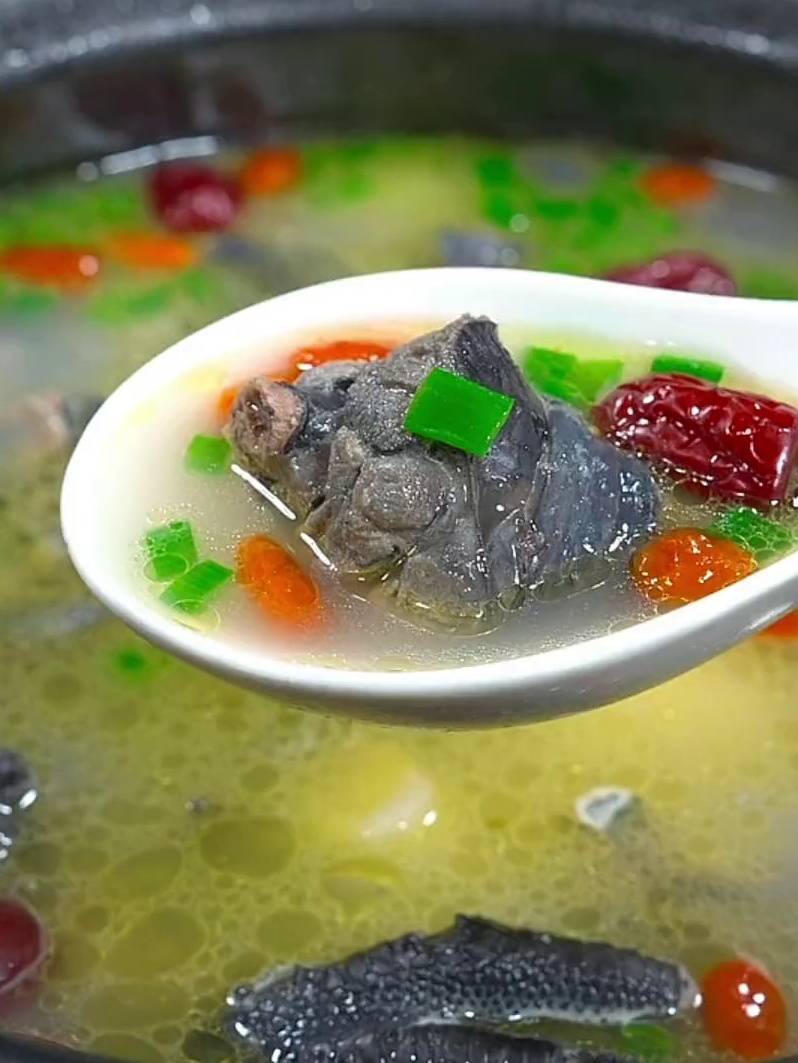
Ingredients
Equipment
Method
Prepare the Ingredients
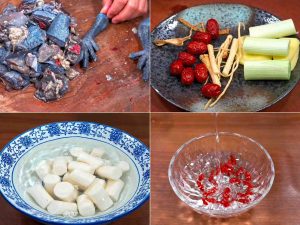
- Prepare 900 g of silkie chicken. Remove the internal organs and any remaining material from the cavity, discard unwanted parts, and cut the chicken into pieces approximately 4 cm in size. Do not repeatedly rinse raw chicken under running water, because splashing can spread contaminated liquid to the sink and surrounding surfaces. You can pat the surface dry with paper towels.
- Cut 50 g of Chinese scallion into pieces approximately 5 cm long. Cut 15 g of fresh ginger into 5 slices.
- Pit 30 g of Chinese red dates. Rinse 4 g of dried angelica root and 8 g of dried codonopsis root with clean water to remove surface dust.
- Place 10 g of goji berries in a small bowl. Add 100 ml of cold water and soak for 10 minutes. Drain the berries afterward. Do not add the soaking water to the soup.
- Wear food-safe gloves and peel 250 g of Chinese yam. Cut it into cubes approximately 2 cm on each side, then place the pieces in cold water to prevent surface discoloration.
Blanch the Chicken to Reduce Odor
- Place 900 g of chicken pieces in a pot. Add 2500 ml of cold water and 15 ml of Chinese rice wine.
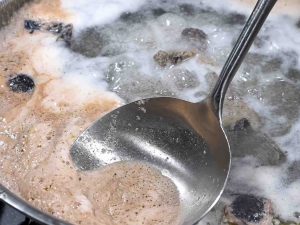
- Heat over high heat until the water boils. Continue boiling for 3 minutes while using a slotted spoon to remove the grayish-white foam from the surface.
- Use a clean slotted spoon to remove the chicken and allow excess water to drain back into the pot. Discard all the blanching liquid. Do not add the blanching liquid to the pot used for the main soup.
Simmer the Chicken Soup
- Transfer the blanched chicken to a clean, covered 4-liter cooking pot. Add 2000 ml of freshly boiled drinking water.
- Add 50 g of Chinese scallion, 15 g of fresh ginger, 30 g of Chinese red dates, 4 g of dried angelica root, and 8 g of dried codonopsis root.
- Heat over medium-high heat until the soup boils. If more foam appears on the surface, remove it with a slotted spoon.
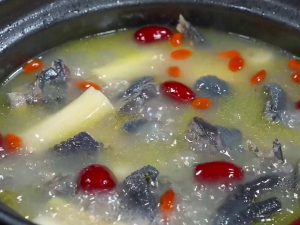
- Cover the pot, reduce the heat, and maintain a gentle simmer for 20 minutes. Near sea level, a gentle simmer is generally around 90–95°C. The surface should show a steady stream of small bubbles rather than a vigorous rolling boil.
Add the Chinese Yam and Finish Seasoning
- After the chicken has simmered for 20 minutes, drain the Chinese yam and add it to the pot.
- Add 10 g of goji berries and 7 g of salt. Cover the pot and continue simmering over low heat for 10 minutes.
- If using 250 g of potatoes instead of Chinese yam, simmer them for approximately 12 to 15 minutes, until a chopstick can pass easily through the potato pieces.
- Use a food thermometer to measure the internal temperature at the thickest part of the largest chicken piece. Avoid touching the bone. The internal temperature must reach at least 74°C. If it has not reached this temperature, continue cooking in 5-minute increments and measure again.
- Once the chicken has reached a safe internal temperature, turn off the heat and remove the Chinese scallion. Serve the chicken, Chinese yam, red dates, and goji berries together with the soup.
Notes
Keep blanching separate from simmering. Use Chinese rice wine only during blanching, then discard all the blanching liquid. Do not add rice wine or cooking wine to the main soup.
Avoid strong spices. Do not add Sichuan peppercorns, star anise, bay leaves, or cinnamon bark. Their strong aromas can overpower the flavors of the chicken, red dates, and ginger.
Control the heat. Maintain a gentle simmer during the main cooking stage. If using a thin-bottomed pot, lower the heat and watch the surface to prevent vigorous boiling.
Check that the chicken is fully cooked. The internal temperature at the thickest part of the chicken must reach at least 74°C. A fixed cooking time does not replace checking the internal temperature.
Substitute for Chinese yam. If Chinese yam is unavailable, replace it with 250 g of potatoes. Potatoes usually need 12 to 15 minutes of simmering. They have a softer texture and make the soup slightly thicker.
Store leftover soup safely. Within 2 hours after cooking, divide the leftover soup into shallow containers and refrigerate. Consume refrigerated soup within 3 to 4 days. Reheat the soup to at least 74°C before serving again.