Silkie Chicken Soup with Chinese Yam and Red Dates

Rate this post

When I make silkie chicken soup at home, I like to preserve the natural flavor of the chicken. I do not add too many spices or use excessive seasonings that could overpower the chicken’s natural taste.

The cooking process is simple. First, I cut the silkie chicken into small pieces and blanch them briefly in boiling water. Then, I add scallions, ginger, red dates, codonopsis root, and angelica root. I add Chinese yam partway through the cooking process. Finally, I season the soup with salt.

This soup is a good choice for a family dinner. The chicken provides a rich savory flavor, the red dates add a mild sweetness, and the Chinese yam adds variety to the soup. For another slow-simmered Chinese soup, try our lotus root and pork rib soup recipe.

For me, the key to making silkie chicken soup with Chinese yam and red dates is proper ingredient preparation, blanching the chicken, controlling the heat, and seasoning the soup at the end. Once the basic ingredients are ready, I can make this soup at home using an ordinary heavy-bottomed pot, even without a traditional clay pot. If you want to use similar aromatics in a main dish, try our ginger and scallion chicken with Chu Hou sauce.

My 5 Key Tips

1. Keep blanching separate from the main cooking process.

I add Chinese rice wine during blanching, then discard the liquid along with the wine. I do not add any more wine when simmering the soup. This helps preserve a clean, clear flavor.

2. Use boiling water for the main cooking process.

I prepare 2,000 milliliters of drinking water and bring it to a boil before adding it to the blanched chicken. This allows me to begin simmering the soup without waiting for cold water to heat up again.

3. Strong spices are not necessary.

I do not use Sichuan peppercorns, star anise, bay leaves, or cinnamon bark. For this soup, scallions, ginger, red dates, and chicken provide enough flavor on their own.

4. Cut the Chinese yam into small pieces.

I cut the Chinese yam into cubes approximately 2 centimeters in size. Pieces of this size are usually easy to cook through during the final 10 minutes. Larger pieces may require a longer cooking time.

5. Do not rely on cooking time alone to determine whether the chicken is done.

The size of the chicken pieces, the thickness of the pot, and the actual heat level can all affect cooking time. The chicken should reach an internal temperature of 74°C (165°F) to ensure that it is safely cooked.
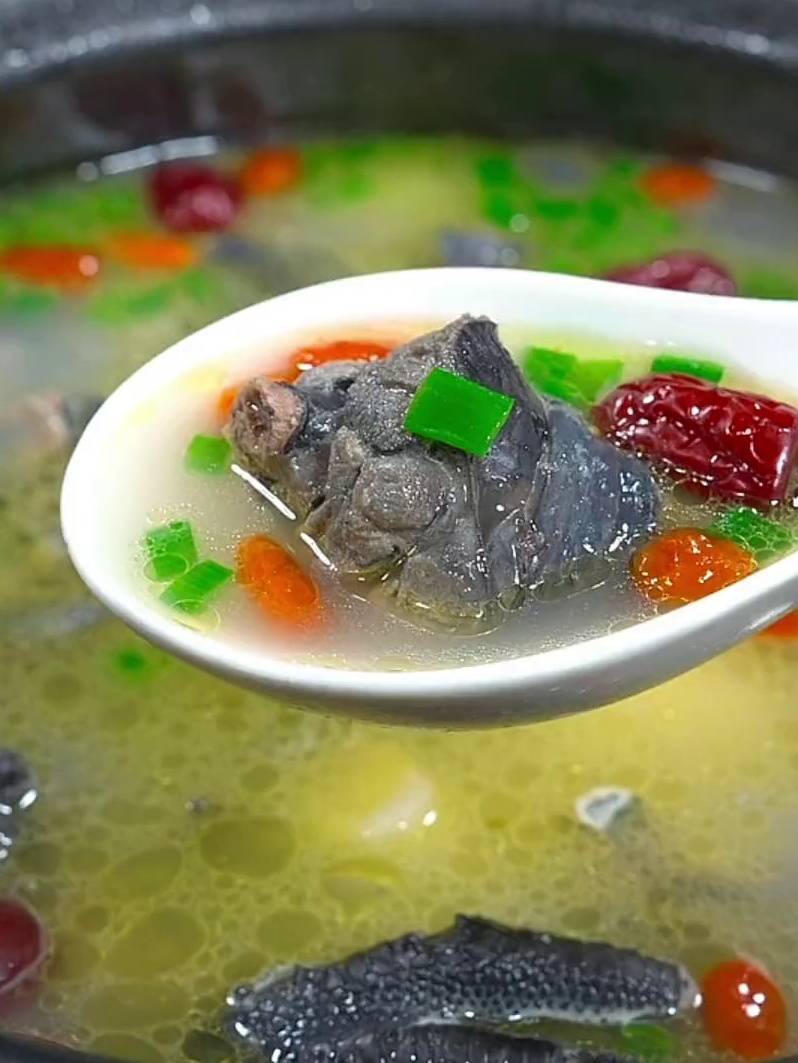
Photo of the finished black-bone chicken soup

Silkie Chicken Soup with Chinese Yam and Red Dates

This homemade soup serves 4 people. It is made with 900 g of silkie chicken, Chinese yam, red dates, goji berries, scallions, ginger, and a small amount of dried herbal roots. First, the chicken is blanched. Then, boiling water and the main ingredients are added, and the soup is simmered for 20 minutes. Chinese yam, goji berries, and salt are added afterward, and the soup is simmered for another 10 minutes. Finally, the internal temperature of the chicken is checked to ensure it reaches 74°C.
Prep Time 25 minutes
Cook Time 40 minutes
Total Time 1 hour 5 minutes
Cuisine: Chinese

Ingredients
  

  • 900 g Silkie chicken Approximately 1 whole chicken, cut into pieces about 4 cm in size. If silkie chicken is unavailable, replace it with 900 g of bone-in chicken thighs. The soup will taste more like ordinary chicken soup, and the fat content may be slightly higher.
  • 2000 ml Drinking water for simmering Use freshly boiled drinking water. Add it to the pot at the beginning of the main simmering stage.
  • 2500 ml Water for blanching Use this water for the initial cooking of the chicken. Discard all the blanching liquid afterward. Do not use it for the main soup.
  • 50 g Chinese scallion Approximately 1 large scallion, cut into pieces about 5 cm long. If Chinese scallions are unavailable, replace them with 50 g of the white part of a leek. The leek will provide a milder aroma and a more noticeable sweetness.
  • 15 g Fresh ginger Approximately 5 slices. Ginger adds a warm, aromatic flavor to the soup.
  • 4 g Dried angelica root Approximately 2 thin slices. Angelica root adds a herbal aroma. If unavailable, omit it. The herbal aroma of the soup will be less pronounced. It is used here only as a flavoring ingredient.
  • 8 g Dried codonopsis root Approximately 2 slender dried roots. If unavailable, omit it rather than replacing it with another spice. It is used here only as a flavoring ingredient.
  • 30 g Chinese red dates Approximately 6 medium-sized Chinese jujubes, pitted. If Chinese red dates are unavailable, replace them with 20 g of pitted dried dates. The soup will become sweeter and develop a more noticeable caramel-like fruit aroma.
  • 10 g Goji berries Soak in 100 ml of cold water for 10 minutes, then drain. If goji berries are unavailable, omit them. Raisins are not a recommended substitute because they add a different sweetness and fruity acidity. Do not add the soaking water to the soup.
  • 250 g Fresh Chinese yam Peel and cut into cubes approximately 2 cm on each side. Place the cut pieces in cold water to prevent discoloration from oxidation. If Chinese yam is unavailable, replace it with 250 g of potatoes. Potatoes contain more noticeable starch, have a softer texture, and make the soup slightly thicker. Potatoes usually need 12 to 15 minutes of simmering.
  • 15 ml Chinese rice wine Use only during blanching. Discard the blanching liquid afterward. If Chinese rice wine is unavailable, replace it with 15 ml of dry white wine, which will produce a more fruit-like aroma, or omit it entirely. Do not add any wine during the main simmering stage.
  • 7 g Salt Add during the final stage, together with the Chinese yam and goji berries, to season the soup.

Equipment

  • 1 4-liter covered cooking pot If you do not have a Chinese clay pot, you can use a 4-liter cast-iron pot or a heavy-bottomed stainless steel pot. A heavy-bottomed pot distributes heat more evenly. If you use a thin-bottomed pot, keep the heat low to prevent the soup from boiling vigorously.
  • 1 Kitchen Knife Use the knife to cut the silkie chicken into pieces approximately 4 cm in size and to cut the scallions, ginger, and Chinese yam. Clean the knife thoroughly after handling raw chicken.
  • 1 Cutting Board Use the cutting board to prepare the ingredients. After handling raw chicken, wash the board with hot water and dish detergent to prevent cross-contamination.
  • 1 Slotted spoon Use the slotted spoon to remove the blanched chicken and skim foam from the surface of the boiling liquid.
  • 1 Food Thermometer Use the thermometer to check the internal temperature at the thickest part of the largest chicken piece. Avoid touching the bone when taking the reading. The internal temperature of the chicken must reach at least 74°C. If you do not have a thermometer, you can cut open the largest piece and check whether the meat is fully cooked, but this method is less accurate.
  • 1 Food-safe gloves Wear the gloves when peeling Chinese yam to reduce direct contact between the skin and the yam's sap.

Method
 

Prepare the Ingredients
  1. Prepare 900 g of silkie chicken. Remove the internal organs and any remaining material from the cavity, discard unwanted parts, and cut the chicken into pieces approximately 4 cm in size. Do not repeatedly rinse raw chicken under running water, because splashing can spread contaminated liquid to the sink and surrounding surfaces. You can pat the surface dry with paper towels.
  2. Cut 50 g of Chinese scallion into pieces approximately 5 cm long. Cut 15 g of fresh ginger into 5 slices.
  3. Pit 30 g of Chinese red dates. Rinse 4 g of dried angelica root and 8 g of dried codonopsis root with clean water to remove surface dust.
  4. Place 10 g of goji berries in a small bowl. Add 100 ml of cold water and soak for 10 minutes. Drain the berries afterward. Do not add the soaking water to the soup.
  5. Wear food-safe gloves and peel 250 g of Chinese yam. Cut it into cubes approximately 2 cm on each side, then place the pieces in cold water to prevent surface discoloration.
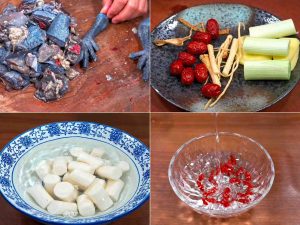
    Making Black-Bone Chicken Soup_Preparing the Ingredients
Blanch the Chicken to Reduce Odor
  1. Place 900 g of chicken pieces in a pot. Add 2500 ml of cold water and 15 ml of Chinese rice wine.
  2. Heat over high heat until the water boils. Continue boiling for 3 minutes while using a slotted spoon to remove the grayish-white foam from the surface.
  3. Use a clean slotted spoon to remove the chicken and allow excess water to drain back into the pot. Discard all the blanching liquid. Do not add the blanching liquid to the pot used for the main soup.
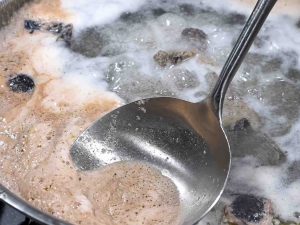
    Making Black-Bone Chicken Soup: Blanching to Remove the Gamey Smell
Simmer the Chicken Soup
  1. Transfer the blanched chicken to a clean, covered 4-liter cooking pot. Add 2000 ml of freshly boiled drinking water.
  2. Add 50 g of Chinese scallion, 15 g of fresh ginger, 30 g of Chinese red dates, 4 g of dried angelica root, and 8 g of dried codonopsis root.
  3. Heat over medium-high heat until the soup boils. If more foam appears on the surface, remove it with a slotted spoon.
  4. Cover the pot, reduce the heat, and maintain a gentle simmer for 20 minutes. Near sea level, a gentle simmer is generally around 90–95°C. The surface should show a steady stream of small bubbles rather than a vigorous rolling boil.
Add the Chinese Yam and Finish Seasoning
  1. After the chicken has simmered for 20 minutes, drain the Chinese yam and add it to the pot.
  2. Add 10 g of goji berries and 7 g of salt. Cover the pot and continue simmering over low heat for 10 minutes.
  3. If using 250 g of potatoes instead of Chinese yam, simmer them for approximately 12 to 15 minutes, until a chopstick can pass easily through the potato pieces.
  4. Use a food thermometer to measure the internal temperature at the thickest part of the largest chicken piece. Avoid touching the bone. The internal temperature must reach at least 74°C. If it has not reached this temperature, continue cooking in 5-minute increments and measure again.
  5. Once the chicken has reached a safe internal temperature, turn off the heat and remove the Chinese scallion. Serve the chicken, Chinese yam, red dates, and goji berries together with the soup.
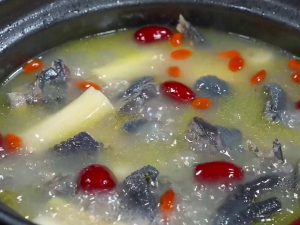
    Finished Black-Bone Chicken Soup

Notes

Keep blanching separate from simmering. Use Chinese rice wine only during blanching, then discard all the blanching liquid. Do not add rice wine or cooking wine to the main soup.
Avoid strong spices. Do not add Sichuan peppercorns, star anise, bay leaves, or cinnamon bark. Their strong aromas can overpower the flavors of the chicken, red dates, and ginger.
Control the heat. Maintain a gentle simmer during the main cooking stage. If using a thin-bottomed pot, lower the heat and watch the surface to prevent vigorous boiling.
Check that the chicken is fully cooked. The internal temperature at the thickest part of the chicken must reach at least 74°C. A fixed cooking time does not replace checking the internal temperature.
Substitute for Chinese yam. If Chinese yam is unavailable, replace it with 250 g of potatoes. Potatoes usually need 12 to 15 minutes of simmering. They have a softer texture and make the soup slightly thicker.
Store leftover soup safely. Within 2 hours after cooking, divide the leftover soup into shallow containers and refrigerate. Consume refrigerated soup within 3 to 4 days. Reheat the soup to at least 74°C before serving again.
Scroll to Top