Go Back
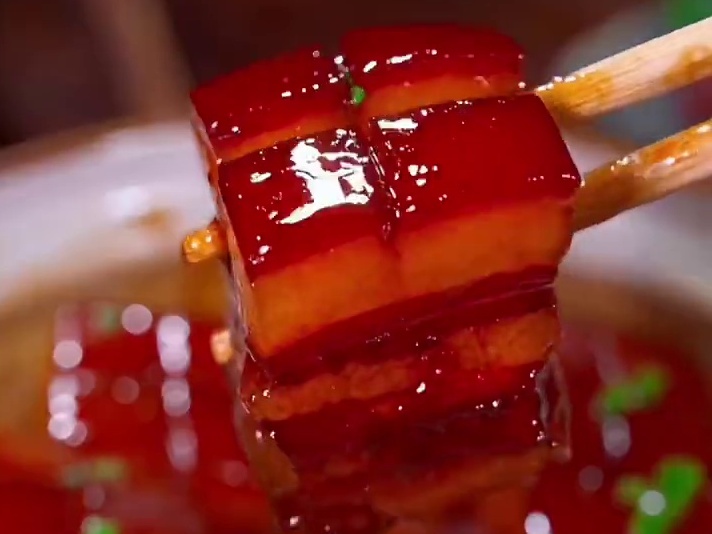
Photos of the Finished Dongpo Pork

Homemade Dongpo Pork

This recipe uses 1000 g of skin-on pork belly. The pork is first steamed with orange peel, then cut into cubes and braised with scallions, ginger, star anise, bay leaves, dried red chilies, rock sugar, soy sauce, oyster sauce, and beer. Finally, the sauce is reduced until thick, giving the pork a glossy reddish-brown color, a tender texture, and a rich flavor. Serves 4–6 people.
Prep Time 20 minutes
Cook Time 2 hours 10 minutes
Resting Time After Steaming 5 minutes
Total Time 2 hours 35 minutes
Cuisine: Chinese

Ingredients
  

  • 1000 g Skin-On Pork Belly Choose a whole piece with alternating layers of fat and lean meat and intact skin. Pork belly is the essential ingredient in this dish. Other cuts of pork cannot fully reproduce the same layered texture and balance of fat and lean meat. If it is unavailable, ask a local butcher to order it or purchase frozen pork belly.
  • 2 pieces Orange Peel Each piece should measure approximately 5 × 5 cm. Wash thoroughly. You can substitute 2 strips of lemon peel, each approximately 5 × 1 cm, but lemon has a sharper citrus aroma and may contribute a more noticeable sour note. You can also omit the peel, although the finished dish will have less citrus aroma.
  • 100 g Scallions Cut 80 g into sections for lining the bottom of the pot and finely chop the remaining 20 g for garnish. Regular green onions or spring onions from a supermarket can be used as substitutes.
  • 30 g Fresh Ginger Slice thinly and use to line the bottom of the pot. Fresh ginger is recommended for its mild, warming aroma.
  • 4 g Star Anise Approximately 2 whole star anise pods. Star anise has a sweet aroma similar to fennel. If unavailable, substitute 1 g of fennel seeds and 1 whole clove, although the aroma will be different. For a flavor closer to traditional Chinese braised pork, consider ordering star anise online.
  • 1 g Bay Leaves Approximately 2 dried bay leaves. They provide a mild herbal aroma. If unavailable, you can omit them, although the overall aroma will be simpler.
  • 2 g Dried Red Chilies Approximately 4 small dried chilies. You can substitute 1 g of crushed red pepper flakes, although the finished dish will contain more small chili particles. You can also omit them.
  • 40 g Rock Sugar Adds sweetness and helps create a rich sauce. If unavailable, substitute 40 g of brown sugar. The finished dish will have a more noticeable molasses-like aroma. White sugar can also be used, but the flavor will be simpler.
  • 15 g White Sugar Used to make caramelized sugar syrup for coloring the pork. Heat the sugar with 30 ml of water until it turns amber, then remove it from the heat and add 50 ml of hot water. Brown sugar can be substituted, but its color changes are harder to control.
  • 60 ml Light Soy Sauce Primarily adds a savory, salty flavor. If Chinese light soy sauce is unavailable, substitute 60 ml of regular soy sauce. If the substitute is particularly salty, reduce the salt in the recipe to 1 g.
  • 20 ml Dark Soy Sauce Primarily adds a deeper color to the pork. If unavailable, substitute 15 ml of regular soy sauce mixed with 5 g of brown sugar. The finished dish may be lighter in color and slightly sweeter.
  • 15 ml Oyster Sauce Adds savory depth and body to the sauce. If unavailable, substitute 10 ml of regular soy sauce, 5 g of brown sugar, and 10 ml of water. The seafood-based savory flavor will be weaker, and the sauce will be slightly sweeter.
  • 2 g Salt Used to adjust the overall saltiness. If the soy sauce substitute is particularly salty, reduce the salt to 1 g.
  • 330 ml Beer Adds a malty aroma and makes the sauce more flavorful. You can substitute 330 ml of non-alcoholic beer for a similar flavor. Alternatively, use 330 ml of water or unsalted meat stock, but the malty aroma will be less noticeable.
  • 1500 ml Water for Braising Use 30 ml to make the caramelized sugar syrup and another 50 ml to dilute it. The remaining 1420 ml is used for braising. If the liquid does not reach the top of the pork, add 100 ml of hot water at a time, up to an additional 300 ml. More liquid will require a longer reduction time.
  • 1500 ml Water for Steaming Used in the bottom of the steamer and should not directly touch the pork. If the water level becomes too low during steaming, add 100 ml of boiling water.

Equipment

  • 1 Steamer or Deep Pot with a Steaming Rack A steamer can be replaced with a deep pot with a lid and a metal steaming rack. The rack must sit above the water level, and the water should remain boiling during steaming. Use 1500 ml of water for steaming. If the water level becomes too low, add 100 ml of boiling water at a time.
  • 1 Heavy-Bottomed Pot with a Lid A pot approximately 24 cm in diameter and at least 12 cm deep is recommended. A cast-iron pot or a heavy-bottomed stockpot can also be used. If using a thin-bottomed pot, reduce the heat to prevent the sauce from evaporating too quickly or the ingredients from sticking to the bottom.
  • 1 Small Saucepan Used to make the caramelized sugar syrup. If you do not have a small saucepan, make the syrup in the braising pot first and transfer it to a heatproof bowl. Then clean the pot before lining the bottom with scallions and ginger.
  • 1 Chef's Knife and Cutting Board Used to cut the pork into cubes approximately 4 cm on each side and to score the pork skin with cross-shaped cuts 3–5 mm deep.
  • 1 Long Chopsticks or Kitchen Tongs Used to check the tenderness of the pork and safely handle the steamed and braised meat.

Method
 

Step 1: Clean and Steam the Pork Belly
  1. Rinse 1000 g of skin-on pork belly and pat the surface dry with paper towels.
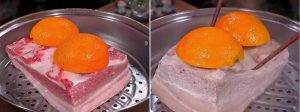
  2. Place the whole piece of pork belly on a steaming rack. Put 2 pieces of orange peel, each approximately 5 × 5 cm, on top of the pork.
  3. Pour 1500 ml of water for steaming into a deep pot. Bring the water to a boil, place the rack inside the pot, and cover with a lid. Keep the water boiling and steam the pork for 50 minutes.
  4. After 50 minutes, insert chopsticks into the thickest part of the pork. If the chopsticks slide in easily, the pork is soft enough to cut. If you still feel significant resistance, steam for another 10 minutes and check again.
  5. Make sure the water in the bottom of the pot does not boil away completely. If the water level becomes too low, add 100 ml of boiling water.
    How to Make Dongpo Pork_Steamed Pork Belly
Step 2: Rest and Cut the Pork
  1. After steaming, turn off the heat and let the pork rest for 5 minutes. Use kitchen tongs to remove the pork, avoiding direct contact with the hot meat.
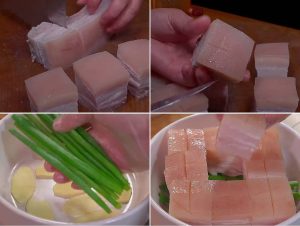
  2. Cut the pork into cubes approximately 4 × 4 cm. Try to keep the pieces similar in size.
  3. If the pieces have skin, score the skin of each piece with cross-shaped cuts approximately 3–5 mm deep. Do not cut all the way through the meat.
  4. Cut 80 g of scallions into long sections and slice 30 g of fresh ginger thinly.
  5. Line the bottom of a heavy-bottomed pot approximately 24 cm in diameter with the scallion sections and ginger slices. Arrange the pork cubes neatly on top.
    How to Make Dongpo Pork_Cut the pork belly into chunks
Step 3: Make the Caramelized Sugar Syrup
  1. Place 15 g of white sugar and 30 ml of the water reserved for braising in a small saucepan.
  2. Heat over medium-low heat for approximately 3–5 minutes. Once the sugar has dissolved and the liquid turns amber, immediately remove the saucepan from the heat.
  3. Do not allow the syrup to become dark brown or start smoking, as this can produce a pronounced burnt and bitter taste.
  4. Slowly add 50 ml of hot water after removing the saucepan from the heat. Be careful, as the hot sugar syrup may splatter. Stir until the syrup is dissolved.
  5. A total of 80 ml of water is used to make the caramelized sugar syrup. The remaining 1420 ml of water is reserved for braising.
Step 4: Add the Seasonings and Beer
  1. Pour the prepared caramelized sugar syrup into the braising pot.
  2. Add 40 g of rock sugar, 4 g of star anise, 1 g of bay leaves, 2 g of dried red chilies, 60 ml of light soy sauce, 20 ml of dark soy sauce, 15 ml of oyster sauce, and 2 g of salt.
  3. Pour in 330 ml of beer and the remaining 1420 ml of water.
  4. Gently shake the pot to distribute the seasonings evenly. Avoid stirring the pork vigorously.
  5. The liquid should reach the top of the pork. If there is not enough liquid, add 100 ml of hot water at a time, up to an additional 300 ml.
Step 5: Cover and Braise for 60 Minutes
  1. Bring the liquid to a boil over medium-high heat. Once continuous bubbles appear, reduce the heat to low and cover the pot.
  2. Braise over low heat for 60 minutes. The liquid should maintain a gentle simmer rather than a vigorous boil.
  3. Check the liquid level during braising. If the liquid has decreased significantly, add 100 ml of hot water and continue cooking.
  4. After 60 minutes, check the pork with chopsticks. They should slide into the meat relatively easily. The pork should be tender while retaining its basic shape.
    How to Make Dongpo Pork_Braising
Step 6: Reduce the Sauce
  1. Use kitchen tongs to remove the pork cubes one by one and place them temporarily on a heatproof plate.
  2. Remove the lid and increase the heat to medium-high. Let the sauce continue boiling for 15 minutes.
  3. Watch the sauce as the water evaporates. It will gradually thicken and develop a deeper color. When you lift some sauce with a spoon, it should coat the back of the spoon in a continuous layer, indicating that it has thickened.
  4. Return the pork to the pot and cook for another 5 minutes. During this time, spoon the sauce over the pork cubes.
  5. Finely chop the remaining 20 g of scallions and sprinkle them over the pork before serving.

Notes

This homemade Dongpo pork recipe uses 1000 g of skin-on pork belly and serves approximately 4–6 people. The total time is about 155 minutes, including 20 minutes of preparation, 130 minutes of cooking, and 5 minutes of resting after steaming.
  • Check the pork after steaming for 50 minutes. If chopsticks do not slide in easily, steam for another 10 minutes.
  • When making the caramelized sugar syrup, remove it from the heat as soon as it turns amber. Add hot water slowly to prevent splattering.
  • Maintain a gentle simmer during braising to prevent the pork cubes from breaking apart due to vigorous boiling.
  • If the pot is wide, the liquid may not reach the top of the pork. Add 100 ml of hot water at a time, up to an additional 300 ml, and allow more time for the sauce to reduce.
  • Light soy sauce primarily adds savory saltiness, while dark soy sauce primarily deepens the color. Regular soy sauce can replace either one, but reduce the salt to 1 g if the substitute is particularly salty.
  • Orange peel adds a mild citrus aroma and can be omitted. Beer can be replaced with non-alcoholic beer. Using water or unsalted meat stock will reduce the malty aroma.
  • Removing the pork while reducing the sauce helps prevent the meat from breaking apart. Return the pork to the pot and heat for another 5 minutes once the sauce has thickened.
  • Refrigerate cooked pork promptly and aim to eat it within 3 days. To reheat, add 30 ml of water, cover the pot, and heat over low heat for 10–15 minutes, until the center of the pork is thoroughly heated.