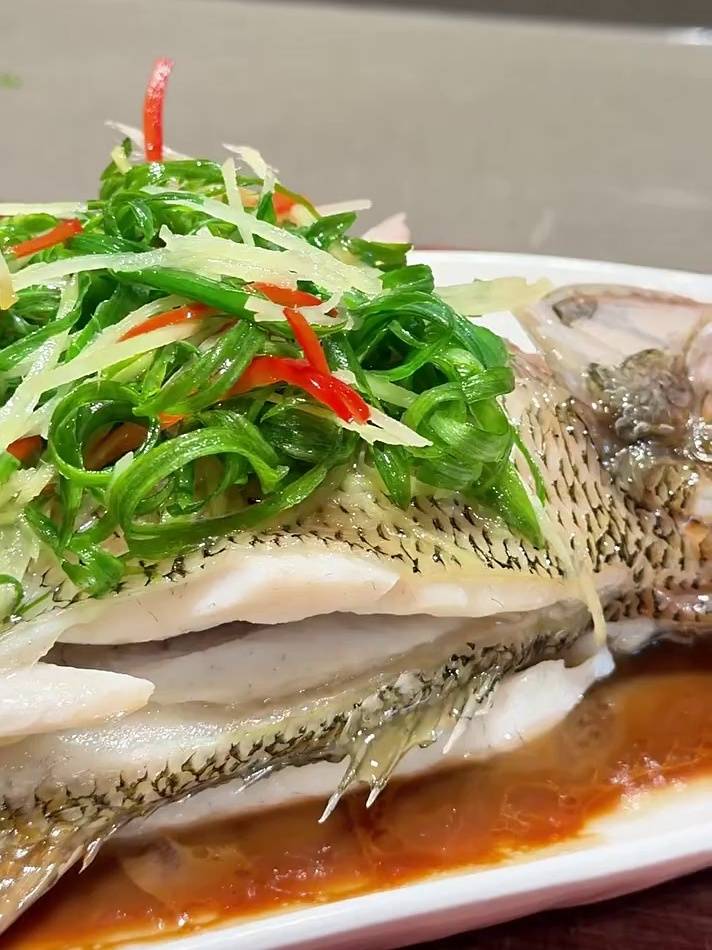
Ingredients
Equipment
Method
Step 1: Clean the Fish and Prepare the Ingredients
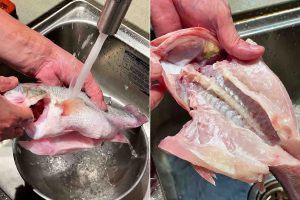
- Rinse one whole sea bass weighing approximately 550 g after scaling and gutting under running water. Pay particular attention to the inside of the belly cavity and the blood near the backbone.
- If the skin has noticeable surface slime, quickly pour warm water at approximately 60°C over the fish from head to tail, then immediately rinse it with clean water. If you cannot measure the water temperature with a thermometer, simply rinse the fish under running water. Do not expose the fish to very hot water for an extended period.
- Pat the fish and its belly cavity dry with paper towels. Make two cuts into the thickest part of the back. Cut into the flesh without severing the backbone.
- Cut 25 g of fresh ginger into thin strips and divide it into two portions of 10 g and 15 g. Cut 35 g of scallions into thin strips and separate 15 g of the white parts from 20 g of the green parts. Cut 8 g of red chili pepper into thin strips, slice 50 g of red onion thinly, and finely chop 10 g of cilantro stems.
Step 2: Season the Fish and Prepare the Plate
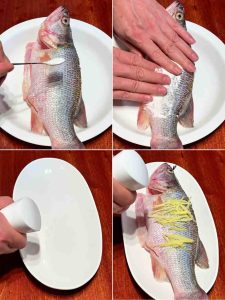
- Rub 2 g of salt evenly over the inside and outside of the fish. Apply 3 g of cornstarch in a thin layer over the fish. There is no need for a prolonged marinating period.
- Coat the bottom of a heatproof fish plate with 5 ml of cooking oil. Place the fish on the plate, arrange 10 g of ginger strips over the fish, and drizzle another 5 ml of cooking oil over it.
Step 3: Steam the Fish
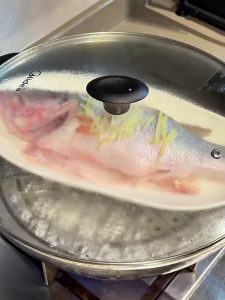
- Pour 1500 ml of water into a lidded deep pot with a diameter of at least 28 cm. Place the steaming rack inside the pot. Make sure the water level is below the rack and does not touch the bottom of the fish plate.
- Bring the water to a steady boil. Place the plate containing the fish on the rack. Cover the pot and steam over high heat for 10 minutes. Do not open the lid during steaming.
- After 10 minutes, measure the internal temperature at the thickest part of the fish using a kitchen thermometer. The fish is ready when the center reaches 63°C. If the temperature is below 63°C, continue steaming for another 2 minutes and measure again.
- If you do not have a thermometer, check that the flesh has turned opaque and separates easily with a fork.
Step 4: Reserve the Steaming Juices and Make the Soy-Based Sauce
- After steaming, pour the liquid from the fish plate into a clean bowl. Measure up to 30 ml of steaming juices. If there is less than 30 ml, add water until the combined liquid reaches 30 ml.
- Add 10 ml of cooking oil to a small saucepan. Once the oil is hot, add 50 g of red onion, 15 g of scallion whites, and 10 g of chopped cilantro stems. Saute for 2 minutes until the ingredients release a noticeable aroma.
- Add the mixture of steaming juices and water totaling 30 ml, along with 30 ml of light soy sauce, 10 ml of oyster sauce, and 4 g of white sugar. Bring the sauce to a boil, then maintain a gentle boil for approximately 2 minutes so the seasonings combine.
- Strain the sauce through a fine-mesh strainer to remove the onion, scallions, and cilantro stems. Keep the strained sauce for serving.
Step 5: Garnish the Fish and Pour Over Hot Peanut Oil
- Arrange 15 g of ginger strips, 20 g of scallion greens, and 8 g of red chili strips over the steamed fish.
- Heat 25 ml of peanut oil in a small saucepan to approximately 180°C. Use a kitchen thermometer to measure the oil temperature. Do not allow the oil to smoke heavily for an extended period.
- Carefully pour the hot peanut oil evenly over the ginger, scallions, and chili on the fish. Keep your hands and face away from the plate to avoid splashing hot oil.
- Finally, pour the prepared soy-based sauce over the fish and around the plate. Serve immediately while hot.
Notes
This recipe uses one whole sea bass weighing approximately 550 g after scaling and gutting. It serves 2 people.
- When cleaning the fish, pay particular attention to the blood inside the belly cavity and near the backbone.
- After steaming for 10 minutes, check the thickest part of the fish. The internal temperature should reach 63°C before serving. Without a thermometer, make sure the flesh is opaque and separates easily.
- Reserve the steaming juices whenever possible. Combine the steaming juices and any additional water to make 30 ml in total, then add 30 ml of light soy sauce. The ratio of liquid to soy sauce is 1:1.
- Heat the peanut oil to approximately 180°C before pouring it over the ginger, scallions, and chili. Take care to avoid splashing hot oil.
- If you do not have a steamer, use a lidded deep pot with a steaming rack. Keep the fish plate stable and ensure that its bottom does not touch the water.
- If sea bass is unavailable, substitute tilapia or sea bream. The flesh texture and thickness will vary, so check the internal temperature rather than relying only on the steaming time.