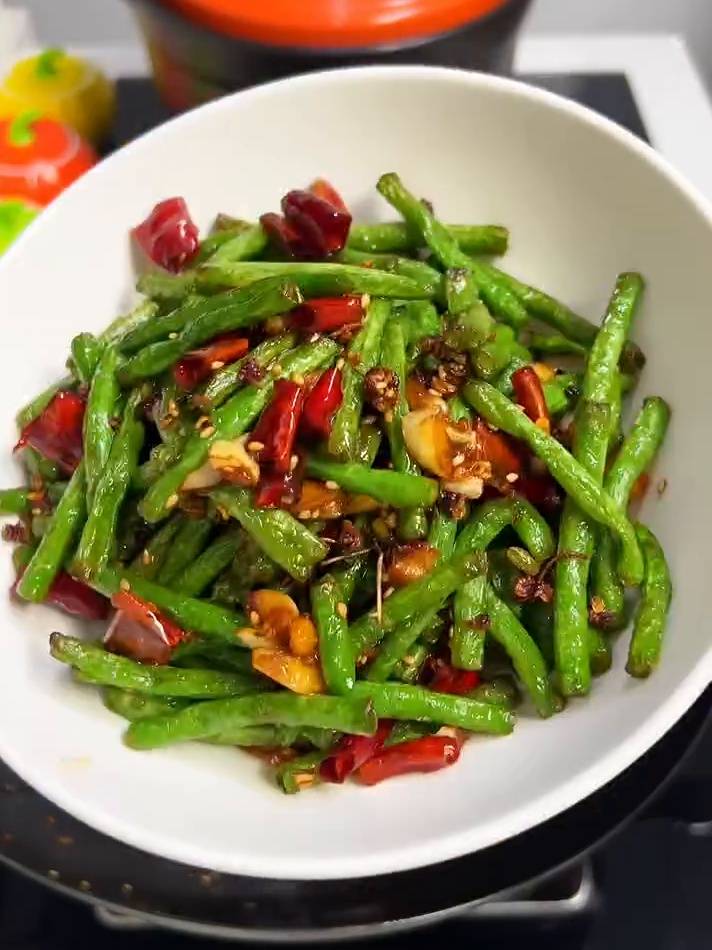
What makes Sichuan-style dry-fried green beans so appealing is their slightly wrinkled exterior, savory aroma, and tender texture. Unlike ordinary stir-fried green beans, this dish relies on cooking off excess moisture before tossing the beans with aromatic seasonings. The result is a vegetable dish with a distinctive dry-fried flavor and plenty of character.
Traditional restaurant-style dry-fried green beans are often prepared with a generous amount of oil. However, you don’t need to deep-fry the beans to achieve a similarly satisfying result at home. By cooking them in a small amount of oil until their skins begin to wrinkle, then tossing them with garlic, ginger, dried chilies, and Sichuan peppercorns, you can create a flavorful dish without using excessive oil.
This version is a simple homemade recipe without minced pork. Green beans are the main ingredient, while garlic and ginger provide an aromatic base. Dried red chilies add heat, Sichuan peppercorns contribute their distinctive fragrance, and toasted sesame seeds bring a pleasant nutty finish.
If you want to compare it with a more traditional version that includes minced pork, see our homemade dry-fried green beans recipe.
The key is not to eliminate oil entirely, but to cook the green beans in stages. First, allow them to release excess moisture through dry-frying. Then add the seasonings so the beans can absorb their savory flavors. There is no need for deep-frying or a complicated sauce.
Gan Bian Dou Jiao (Sichuan-Style Dry-Fried Green Beans)
Ingredients
Equipment
Method
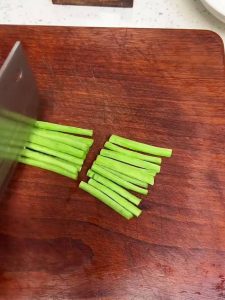
- Wash 300 g of green beans, trim both ends, and cut them into 5–6 cm pieces. Drain thoroughly and pat dry with paper towels. Finely mince 3 garlic cloves and 10 g of fresh ginger. Cut 4 dried red chilies into small sections and prepare 1 g of Sichuan peppercorns.
- In a small bowl, combine 15 ml of light soy sauce, 1 g of salt, 1 g of chicken bouillon powder, and 2 g of white sugar. Set aside.
- Preheat a wok over medium-high heat for about 1 minute. Add 10 ml of cooking oil and swirl to lightly coat the bottom.
- Add the green beans and cook over medium to medium-high heat for 8–10 minutes, stirring frequently with a wok spatula so they cook evenly. Do not add water or cover the wok.
- When the skins begin to wrinkle and develop a few light golden-brown spots, check that the centers are tender and fully cooked. If they are still firm, continue cooking for another 1–2 minutes. Transfer the cooked beans to a plate.
- Keep the wok over medium to medium-low heat and add the remaining 5 ml of cooking oil.
- Add the Sichuan peppercorns and dried red chilies. Stir-fry for 10–15 seconds until fragrant. Add the minced garlic and ginger and continue stir-frying for 15–20 seconds until aromatic. Do not allow the garlic or chilies to burn.
- Return the cooked green beans to the wok and increase the heat to medium-high. Add the prepared light soy sauce, salt, chicken bouillon powder, and sugar mixture.
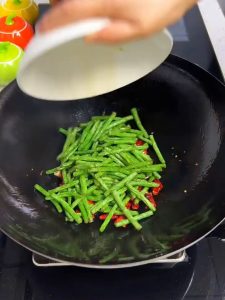
- Toss and stir-fry for 1–2 minutes until the seasonings are evenly distributed over the green beans. Avoid adding excess water, which would soften their dry-fried texture.
- Add 5 g of toasted sesame seeds and toss for another 10 seconds. Taste and adjust the seasoning if necessary.
- Make sure the green beans are thoroughly cooked, then turn off the heat. Transfer to a serving plate and serve hot.
Notes
Why Do Green Beans Need to Be Dry-Fried First?
The main difference between dry-frying and ordinary vegetable stir-frying is how moisture is handled during cooking.
If freshly washed green beans go straight into the wok without being dried, the water on their surface can lower the cooking temperature. Instead of developing a lightly wrinkled exterior, the beans may end up steaming in their own moisture. Although this can soften them, it does not create the characteristic texture of dry-fried green beans.
Two details make a noticeable difference:
- Dry the beans thoroughly before cooking: After washing, drain the green beans well and pat them dry with paper towels. This helps prevent excess moisture from accumulating in the wok.
- Give the beans enough time to cook: Let them cook before adding the seasonings. As they gradually lose moisture, their skins begin to shrink and develop slight wrinkles, along with a few lightly browned spots.
For a low-oil version, a wide wok works particularly well. It allows more of the beans to come into contact with the hot cooking surface, helping moisture evaporate more efficiently. If your wok is too small, cook the beans in batches rather than overcrowding the pan.
One important point: the goal is not simply to brown the outside. The beans must also be thoroughly cooked inside. Once their skins begin to wrinkle, check a piece to make sure the interior is tender rather than firm or undercooked.
Garlic, Ginger, Chilies, and Sichuan Peppercorns Build the Flavor
Green beans have a relatively mild flavor, so much of this dish’s character comes from its combination of aromatics and spices.
Garlic provides the main savory aroma. Finely minced garlic releases its fragrance quickly when cooked in hot oil, allowing its flavor to coat the green beans. However, garlic burns easily, so it should only be stir-fried briefly.
Fresh ginger adds a warm, slightly sharp aroma that makes the overall flavor more complex. You don’t need a large amount, as too much ginger can overpower the natural taste of the green beans.
Dried red chilies provide heat and create an attractive contrast with the green beans. You can adjust the amount according to your preference. Dried chilies have a concentrated flavor, while fresh red chilies offer a different, somewhat fresher kind of heat.
Sichuan peppercorns are another ingredient worth keeping in this recipe. Unlike ordinary black pepper, they have a distinctive citrus-like fragrance and produce a mild tingling sensation on the tongue. A small amount is enough to add complexity without overwhelming the other ingredients.
It is best to cook these aromatics after the green beans have been partially cooked and temporarily removed from the wok. This prevents the garlic and chilies from burning while the beans are cooking.
A Simple Seasoning Is All This Dish Needs
Unlike dishes that rely on thick, rich sauces, dry-fried green beans get most of their flavor from light soy sauce, salt, chicken bouillon powder, and a little sugar.
Light soy sauce provides the main salty and savory notes. There is no need to add dark soy sauce because this dish does not require a deep-colored sauce. Keeping the natural green color of the beans makes the finished dish look more appealing.
Salt and chicken bouillon powder help balance the overall seasoning. Chicken bouillon powder adds savory depth, but different brands can vary considerably in saltiness. Keep this in mind when adjusting the amount of salt.
A small amount of white sugar is not intended to make the dish sweet. Instead, it helps balance the saltiness of the soy sauce and the heat from the chilies and Sichuan peppercorns.
Toasted sesame seeds are best added at the end. Their nutty aroma complements the garlic and spices, giving the green beans a more rounded flavor.
Avoid adding too much water during the final seasoning stage. Excess liquid can make the beans steam again, softening the slightly wrinkled texture created during dry-frying.
Where to Find the Ingredients Outside China
The ingredients for this recipe are relatively simple, and most can be found in regular supermarkets or Asian grocery stores.
| Ingredient | Where to Buy |
|---|---|
| Green beans | Regular supermarkets or Asian grocery stores |
| Garlic | Regular supermarkets |
| Fresh ginger | Regular supermarkets |
| Dried red chilies | Regular supermarkets or Asian grocery stores |
| Sichuan peppercorns | Asian grocery stores or online retailers |
| Light soy sauce | Asian grocery stores or larger supermarkets |
| Chicken bouillon powder | Asian grocery stores |
| Toasted sesame seeds | Regular supermarkets or Asian grocery stores |
If you cannot find the slender Chinese green beans commonly used in Chinese cooking, regular fresh green beans are a suitable alternative. Chinese long beans, if available at an Asian grocery store, can also work well.
Keep in mind that different varieties of green beans vary in thickness and moisture content. Thicker beans generally take longer to cook, so do not rely on cooking time alone to determine when they are ready.
Common Problems When Making Low-Oil Dry-Fried Green Beans
1. The beans have been cooking for a long time but lack that dry-fried aroma.
This usually happens when the beans are too wet, the wok is not hot enough, or too many beans are added at once.
Before cooking, pat the beans thoroughly dry and use a sufficiently wide wok. Turn them regularly so they cook evenly, but avoid stirring constantly every few seconds.
2. The outside looks browned, but the inside is still undercooked.
This is often caused by excessive heat. The exterior browns quickly, but the heat does not have enough time to cook the inside.
Reduce the heat slightly and allow the beans to cook longer. Check their texture rather than relying on color alone.
3. The garlic and chilies burn easily.
Aromatics do not need to cook as long as the green beans. Once the beans have been removed from the wok, reduce the heat to medium-low before adding the garlic, ginger, chilies, and Sichuan peppercorns. Stir-fry briefly until fragrant.
4. The finished dish is too salty or too spicy.
Light soy sauce, salt, and chicken bouillon powder all contribute saltiness, so increasing all three at the same time can easily make the dish overly salty.
Similarly, use dried chilies and Sichuan peppercorns in moderation. Their purpose is to add fragrance and complexity, not completely overpower the natural flavor of the green beans.
What to Serve with Dry-Fried Green Beans
A bowl of freshly steamed rice is probably the simplest and most satisfying accompaniment.
The savory, slightly dry-fried texture of the green beans pairs naturally with soft, fluffy rice. The garlic, chili, and Sichuan peppercorn flavors also make an ordinary bowl of rice much more enjoyable.
For another Chinese-style vegetable side with a softer, simmered finish, try our stir-fried yardlong beans with garlic and red bell pepper.
For a more complete Chinese-style home-cooked meal, serve the beans with steamed eggs, a simple stir-fried vegetable dish, or a light soup. These milder dishes balance the stronger flavors of the green beans without making the meal feel too heavy.
This dish is best enjoyed hot and freshly cooked. As it sits, moisture gradually softens the beans, and their slightly wrinkled texture becomes less noticeable. Serving them immediately after cooking gives you the best combination of aroma and texture.