Go Back
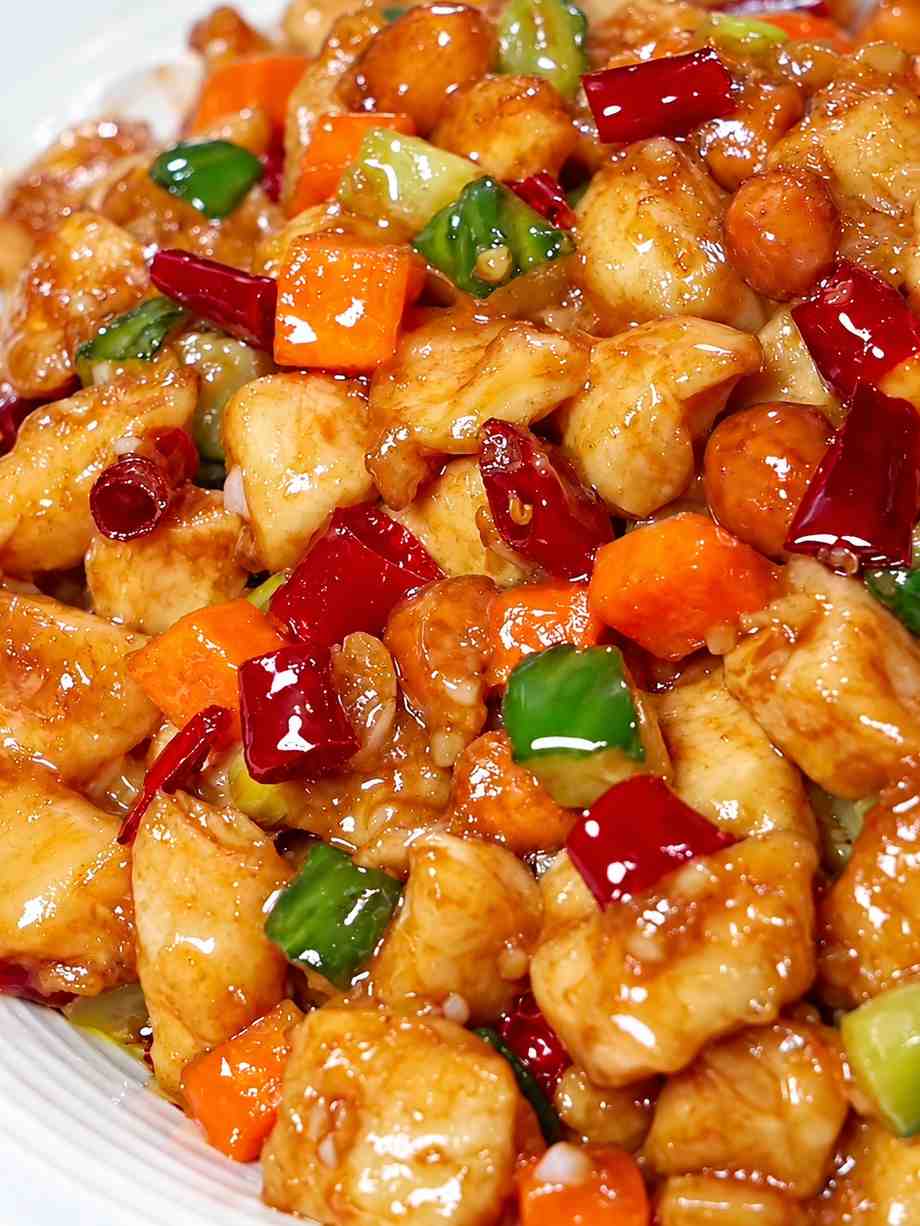
Photo of the finished Homestyle Kung Pao Chicken

Homestyle Kung Pao Chicken

This is a home-style Kung Pao Chicken dish suitable for 2 to 3 people. The chicken breast is marinated in egg white, cornstarch, and cooking oil, then stir-fried with carrots, cucumbers, dried red chili peppers, and a sweet-and-sour sauce. Unsalted, roasted peanuts are added at the end. Preparation time is about 20 minutes, cooking time is about 10 minutes, and total time is about 30 minutes.
Prep Time 20 minutes
Cook Time 10 minutes
Marinating time (included in the preparation time) 10 minutes
Total Time 30 minutes
Cuisine: Chinese

Ingredients
  

  • 400 gram Skinless chicken breast Cut into small cubes of about 1.5 centimeters on each side. You can also use 400 grams of skinless, boneless chicken thighs, which usually yield a more succulent texture.
  • 2 gram Salt For marinating 400 grams of chicken breast.
  • 0.5 gram White pepper powder Used to enhance the aroma. If you can't find ground white pepper, you can substitute 0.5 grams of ground black pepper; the aroma of black pepper will be more pronounced.
  • 25 milliliters Light Soy Sauce Use 10 milliliters for marinating the chicken and 15 milliliters for making the sauce. Light soy sauce is lighter in color and is mainly used for seasoning. If you’re substituting dark soy sauce, reduce the amount of light soy sauce in the sauce from 15 milliliters to 10 milliliters.
  • 30 gram Egg whites The egg white from about one large egg. Use exactly 30 grams to help the marinade coat the chicken evenly.
  • 24 gram Corn Starch Use 16 grams for marinating the chicken and 8 grams for making the sauce. Based on standard measuring spoons, this is approximately 2 level tablespoons plus 1 level tablespoon; however, when weighing the ingredients, use grams as the standard.
  • 40 milliliters Cooking Oil Use 10 milliliters for marinating chicken, and 30 milliliters for stir-frying chicken and side dishes.
  • 25 gram Granulated Sugar Used to prepare a sweet-and-sour sauce. This is approximately equivalent to 2 level tablespoons; based on a standard tablespoon of 15 milliliters, use the gram measurement as a guide when weighing.
  • 45 milliliters Black Vinegar This is roughly equivalent to 3 tablespoons, with each tablespoon being 15 milliliters. If you can’t find Chinese aged vinegar, you can substitute 30 milliliters of rice vinegar and 15 milliliters of Italian balsamic vinegar. The acidity and fruity aroma will be slightly different with this substitution.
  • 7.5 milliliters Dark soy sauce About half a tablespoon; this is mainly used to deepen the color of the sauce. If you can’t find dark soy sauce, you can substitute 7.5 milliliters of regular light soy sauce and reduce the amount of light soy sauce in the sauce from 15 milliliters to 10 milliliters. The finished dish will be slightly lighter in color after making this substitution.
  • 120 milliliters Clear Water Used to make sauces. 120 milliliters is approximately half of a 240-milliliter measuring cup.
  • 100 gram Carrots Cut into small cubes about 1 centimeter on each side.
  • 100 gram Cucumber Cut into small cubes about 1 centimeter on each side. This will help maintain some texture when stir-frying.
  • 6 gram Dried Red Chili Peppers Cut into pieces about 2 centimeters long. If you can’t find Chinese dried red chili peppers, you can substitute an equal weight of regular dried red chili peppers. If you can only find crushed chili peppers, use 3 grams; however, the rate at which the aroma and heat are released will be different.
  • 10 gram Garlic Chop the garlic into small pieces to sauté the ingredients.
  • 10 gram Ginger Finely chop the ginger to sauté the ingredients.
  • 20 gram Green Onions Cut into small pieces or chop finely to add flavor.
  • 60 gram Unsalted Roasted Peanuts Add them last to preserve their crispiness as much as possible. If you can’t find roasted peanuts, you can use unsalted roasted peanuts. If you only have raw peanuts, first stir-fry them in a dry skillet over low heat for 6 to 8 minutes, until they turn a light golden brown. Let them cool completely, then weigh out 60 grams.

Equipment

  • 1 28-centimeter wok If you don’t have a wok, you can use a thick-bottomed skillet with a 28-centimeter diameter. If the skillet is smaller than 28 centimeters in diameter, divide the 400 grams of chicken into two batches of 200 grams each and stir-fry them separately to prevent the chicken pieces from piling up.
  • 1 Kitchen Knife and Cutting Board Use a sharp, standard kitchen knife and a clean cutting board. Handle raw chicken and vegetables separately, and thoroughly clean the knife and cutting board after use.
  • 2 Serving Bowl Use one bowl for marinating the chicken and another for making the sauce. A regular deep dish can also be used in place of a mixing bowl.
  • 1 Standard measuring spoon or measuring cup with markings A standard tablespoon holds 15 milliliters, and a standard teaspoon holds 5 milliliters. Liquids can be measured using a graduated measuring cup, and it is recommended to weigh solid ingredients using a kitchen scale.
  • 1 Kitchen Scale Used for weighing chicken, vegetables, starch, salt, and white sugar. Without a kitchen scale, it can be difficult to accurately measure the weight of solid ingredients.
  • 1 Heat-Resistant Spatula You can use a heat-resistant wooden spatula or a silicone spatula. When stir-frying, spread the chicken cubes out as much as possible across the bottom of the pan.
  • 1 Kitchen Thermometer We recommend using a kitchen thermometer to check the internal temperature of the largest piece of chicken to ensure it reaches 74 degrees Celsius. A thermometer is more reliable than simply checking the color of the chicken.

Method
 

Step 1: Cut and Marinate the Chicken
  1. Cut 400 grams of chicken breast into small cubes about 1.5 centimeters on each side, trying to keep the pieces as uniform in size as possible.
  2. Place the diced chicken in a mixing bowl, then add 2 grams of salt, 0.5 grams of white pepper, 10 milliliters of light soy sauce, 30 grams of egg white, and 16 grams of cornstarch.
  3. Mix with your hands for about 1 minute, until each piece of chicken is evenly coated with the marinade.
  4. Add 10 milliliters of cooking oil, then toss for about 20 seconds.
  5. Marinate the chicken for 10 minutes. While it’s marinating, prepare the vegetables and sauce.
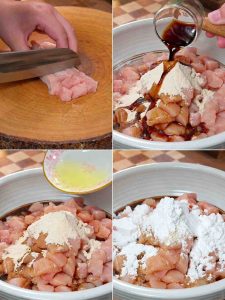
    Homestyle Kung Pao Chicken_Marinating the Chicken
Step 2: Make the sweet-and-sour sauce
  1. In another mixing bowl, combine 25 grams of white sugar, 45 milliliters of aged vinegar, 15 milliliters of light soy sauce, 7.5 milliliters of dark soy sauce, 120 milliliters of water, and 8 grams of cornstarch.
  2. Stir thoroughly until the sugar is fully dissolved and there are no visible lumps of starch at the bottom of the bowl.
  3. Place the sauce next to the wok. Stir it again before pouring it into the wok to ensure the cornstarch that has settled at the bottom of the bowl is thoroughly mixed in.
Step 3: Prepare the vegetables and spices
  1. Cut 100 grams of carrots and 100 grams of cucumbers into small cubes, each about 1 centimeter on a side.
  2. Finely chop 10 grams of garlic and 10 grams of ginger, and cut 20 grams of green onions into small pieces or finely chop them.
  3. Cut 6 grams of dried red chili peppers into pieces about 2 centimeters long. If you want to reduce the heat, you can remove the seeds.
  4. Place 60 grams of unsalted, roasted peanuts in a separate bowl and set aside.
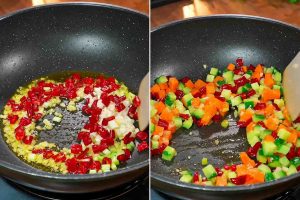
    Homestyle Kung Pao Chicken_Stir-Fried Spices and Side Dishes
Step 4: Stir-frying the chicken cubes in the first round
  1. Preheat a 28-centimeter wok to about 180 degrees Celsius. Pour in 20 milliliters of cooking oil and watch for fine ripples to form on the surface of the oil, but do not wait until the oil begins to smoke noticeably.
  2. Add the marinated chicken cubes and quickly toss them with a spatula to spread them out as much as possible across the bottom of the pan.
  3. Stir-fry for about 2 to 3 minutes, until most of the chicken cubes have turned white.
  4. Transfer the diced chicken to a clean plate and set it aside. After the first round of stir-frying, the chicken needs to continue cooking with the sauce.
  5. If using a pan smaller than 28 centimeters in diameter, divide the 400 grams of chicken into two batches of 200 grams each and stir-fry them separately.
Step 5: Sauté the seasonings and vegetables until fragrant
  1. Add the remaining 10 milliliters of cooking oil to the wok.
  2. Add 10 grams of garlic, 10 grams of ginger, 20 grams of scallions, and 6 grams of dried red chili peppers. Stir-fry over medium heat for about 20 to 30 seconds, until you can smell a distinct aroma.
  3. Add 100 grams of diced carrots and 100 grams of diced cucumbers, then turn the heat to high and stir-fry for about 1 to 2 minutes.
  4. The carrots should be thoroughly cooked, while the cucumbers should retain some crunch.
Step 6: Return the chicken cubes to the pan, reduce the sauce, and add the peanuts
  1. Return the chicken cubes that were stir-fried in the first round to the pan.
  2. Stir the prepared sauce again, then pour it into the wok.
  3. Keep the heat high and stir-fry quickly for about 1 to 2 minutes, so that the chicken and vegetables are evenly coated with the sauce. Check to see if the sauce has thickened and is clinging to the surface of the ingredients.
  4. Use a kitchen thermometer to check the internal temperature of the largest chicken cube to ensure it reaches 74 degrees Celsius. The chicken must be thoroughly cooked.
  5. Add 60 grams of unsalted, roasted peanuts and stir-fry for about 10 seconds.
  6. Turn off the heat immediately, transfer the Kung Pao chicken to a serving plate, and serve while hot.

Notes

Chicken Preparation: Cut the chicken breast into small cubes about 1.5 centimeters on each side. Marinate for 10 minutes. After the first round of stir-frying, remove the chicken from the pan and set aside; return it to the pan later to continue heating with the sauce.
Sauce Measurements: A standard tablespoon is 15 milliliters, and a standard teaspoon is 5 milliliters. 25 grams of white sugar is approximately equal to 2 level tablespoons, and 45 milliliters of aged vinegar is equal to 3 tablespoons. When measuring, use grams and milliliters as your guide.
Substitutions: If you cannot find Chinese aged vinegar, use 30 ml of rice vinegar and 15 ml of Italian balsamic vinegar. If you cannot find dark soy sauce, use 7.5 ml of regular light soy sauce instead, and reduce the amount of light soy sauce in the sauce from 15 ml to 10 ml.If you can’t find white pepper powder, you can use 0.5 grams of black pepper powder.
Adjusting Spiciness: The basic recipe calls for 6 grams of dried red chili peppers. To reduce the spiciness, use 3 grams of dried red chili peppers and remove the seeds. If using 3 grams of crushed red pepper, the heat will develop more quickly.
Cookware Substitutes: If you don’t have a wok, you can use a 28-centimeter-diameter heavy-bottomed skillet. If the pan is smaller than 28 centimeters in diameter, cook the chicken in two batches of 200 grams each.
Food Safety: Wash your hands, knives, and cutting board thoroughly after handling raw chicken. The chicken must be cooked through completely; the center of the largest chicken cubes should reach 74 degrees Celsius. Do not serve the chicken from the first batch as a finished dish if it is not fully cooked.
Keeping the Peanuts Crispy: Add the cooked peanuts at the very end, stir-fry for about 10 seconds, and then immediately turn off the heat. If the peanuts remain in the moist sauce for too long, they will lose their crispiness.