Go Back
suancaiyu Product Images

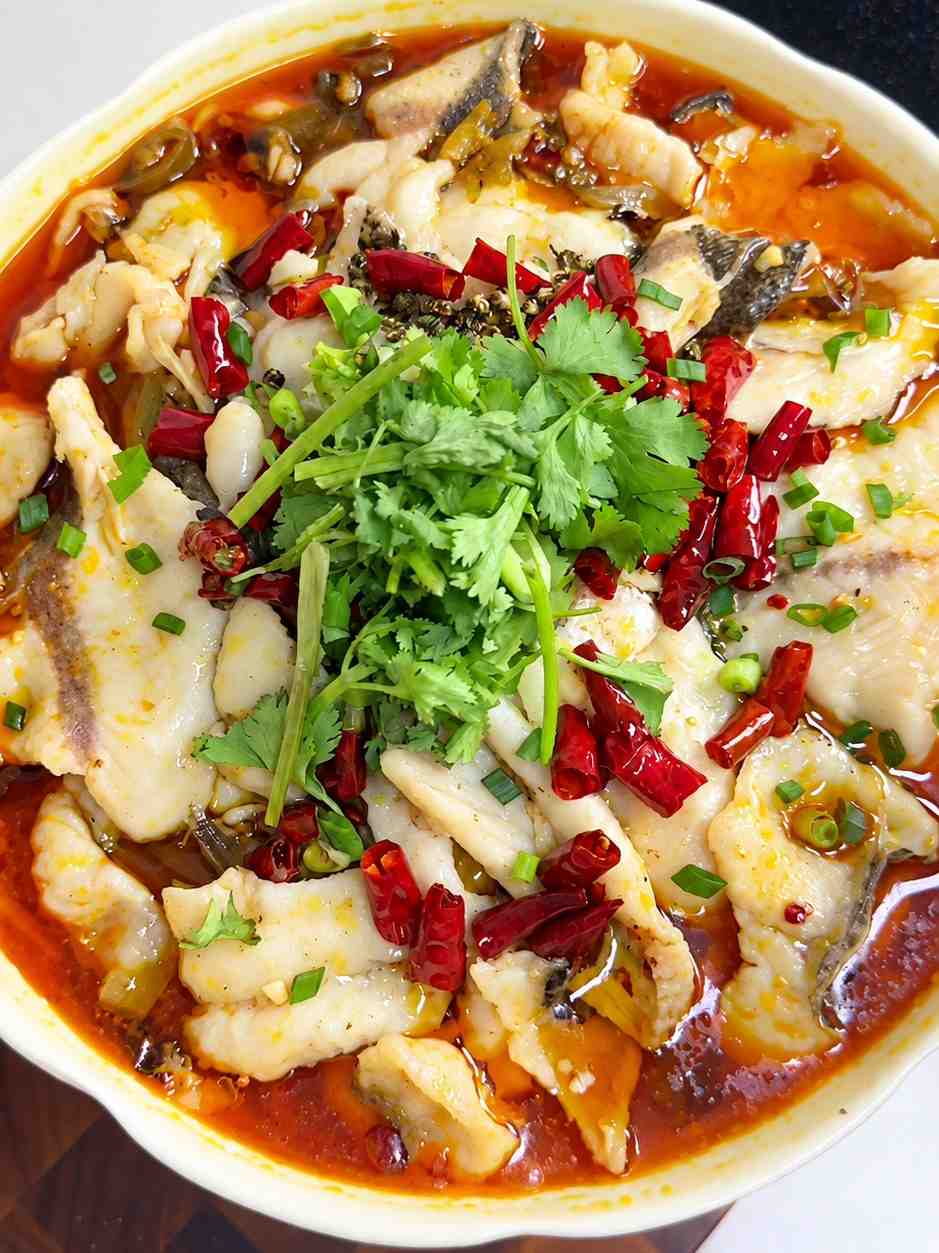
Homestyle Fish with Pickled Mustard Greens (Suancai Yu)

A homestyle pickled-mustard-greens fish for 3–4 people. The fish slices are first marinated with ginger-scallion water, salt, MSG, black pepper and cornstarch, then simmered with pan-seared fish head and bones, pickled mustard greens, pickled chili and chili bean paste. Finally, dried red chilies, Sichuan peppercorns and sizzling hot oil are added for aroma.
Prep Time 20 minutes
Cook Time 30 minutes
Marinating time 10 minutes
Total Time 1 hour
Cuisine: Chinese

Ingredients
  

  • 600 g White-fleshed fish fillets Sliced thin, about 4 mm thick. Tilapia, sea bass or cod all work. Tilapia is mild and absorbs the hot-and-sour broth well; cod is more delicate and breaks apart more easily when stirred.
  • 300 g Fish head and bones Use the head and bones from the same fish; sear until golden on both sides, then use for the broth. If unavailable, replace the 1000 ml water in the broth with 700 ml water plus 300 ml unsalted fish stock. It will still taste savory, but the aroma from searing the bones will be weaker.
  • 250 g Fermented pickled mustard greens Fermented mustard greens (suancai), weighed after draining. If unavailable, substitute 250 g fermented pickled cabbage (sauerkraut), rinsed quickly and squeezed dry before use. The acidity will be more pronounced and the mustard aroma weaker. Regular Korean kimchi can also be substituted in the same 250 g amount, but it adds garlic, ginger and heat. If no fermented pickled greens are available at all, buying Sichuan suancai online is recommended; fresh cabbage with vinegar cannot fully reproduce the fermented flavor.
  • 30 g Pickled chili Drained and cut into pieces. If unavailable, substitute 15 g fresh red chili plus 10 ml white vinegar. The heat will be more direct and the fermented aroma developed during pickling will be missing.
  • 20 g Chili paste Preferably a chili paste without pronounced sweetness. If the local supermarket only carries sweet chili sauce, use 15 g instead; the result will be sweeter, so reduce the salt in the broth by 1 g.
  • 150 g Bean sprouts Mung bean or soybean sprouts. If unavailable, substitute 150 g finely shredded cabbage, which turns softer and sweeter when cooked.
  • 80 g Dried mung bean vermicelli Soak in warm water at 40–50°C (104–122°F) for 10 minutes, then drain. 80 g dried thin rice noodles can be substituted, but the texture and springiness differ; adjust the soaking time according to the package instructions.
  • 25 g Fresh ginger 10 g is minced for the ginger-scallion water; the remaining 15 g is sliced or shredded for the broth base.
  • 25 g Garlic 15 g is sliced for the broth base; the remaining 10 g is minced for the final hot-oil finishing.
  • 30 g Scallions 10 g goes into the ginger-scallion water, 10 g is cut into sections for the broth base, and the last 10 g is chopped for garnish.
  • 15 g Cilantro Chopped and sprinkled over the fish at the end. Can be omitted if unavailable, or replaced with 10 g flat-leaf parsley, whose milder aroma will not fully replicate cilantro.
  • 15 g Dried red chilies Snipped into short pieces and placed on the fish with the Sichuan peppercorns. The standard amount is 15 g; reduce to 5 g for a milder heat.
  • 5 g Sichuan peppercorns For the final hot-oil bloom, adding a citrusy aroma and light numbing sensation. Regular black pepper cannot fully replace its flavor. Omit if unavailable; for an authentic Sichuan profile, buying them online is recommended.
  • 15 g Cornstarch Mixed into the fish slices by hand to form a thin coating. 15 g potato starch can be substituted. All-purpose flour forms a thicker coating and is not an ideal substitute.
  • 60 ml Cooking oil Divided into 3 portions: 20 ml for searing the fish head and bones, 20 ml for the broth base, and 20 ml for the final hot-oil finishing. Heat the last portion to 170–180°C (338–356°F); do not let it keep smoking.
  • 1050 ml Water Divided into 2 portions: 50 ml for the ginger-scallion water and 1000 ml for the broth. Without the fish head and bones, replace the 1000 ml broth water with 700 ml water plus 300 ml unsalted fish stock; the ginger-scallion water still uses 50 ml.
  • 5 g Salt Divided into 2 portions: 3 g for marinating the fish and 2 g for seasoning the broth. If the pickled greens are already very salty, add only 1 g to the broth, for a total of 4 g in the whole dish.
  • 2 g MSG Divided into 2 portions: 1 g for marinating the fish and 1 g for the broth. It can be omitted if unavailable or not used, though the broth will be slightly less savory.
  • 1 g Ground black pepper Used in the fish marinade to add a mild, warm spiciness.

Equipment

  • 1 Heavy-bottomed wok About 30 cm in diameter is recommended. Without a wok, use a deep heavy-bottomed skillet of 28–30 cm. If the pan is shallow, use a stockpot of at least 4 liters, though searing the fish head and bones will not develop the same depth of flavor.
  • 1 Kitchen Knife A regular kitchen knife works fine; make sure the blade is sharp before slicing so you can cut even slices about 4 mm thick.
  • 1 Cutting Board Use a stable, non-slip kitchen board. Wash and sanitize it promptly after handling raw fish to avoid cross-contact with cooked food.
  • 2 Large bowls One for marinating the fish slices and one for prepping the side ingredients. Food-safe containers can be used instead.
  • 1 Fine-mesh strainer For straining the ginger-scallion water. A fine tea strainer can be used instead.
  • 1 Spatula A heat-resistant spatula for stir-frying the ginger, garlic, pickled chili and pickled mustard greens.
  • 1 Slotted spoon For lifting out the fish head and bones, bean sprouts and glass noodles. A perforated soup spoon or heat-resistant strainer can be used instead.
  • 1 Deep serving dish At least 2.5 liters, for holding the fish head and bones, side ingredients, fish slices and broth. A heatproof soup bowl or clay pot can be used instead.
  • 1 Kitchen Scale For accurate weighing. Without a scale, use measuring tools with graduations to estimate, though the margin of error will be larger for small amounts of seasonings.
  • 1 Food Thermometer Optional. Insert the probe into the center of the thickest slice and confirm it reaches 63°C (145°F). Without a thermometer, make sure the flesh is completely opaque and flakes easily.

Method
 

Prepare and marinate the fish slices
  1. Slice 600 g white-fleshed fish into thin pieces about 4 mm thick, keeping the thickness as even as possible. Check 300 g fish head and bones, remove any remaining blood clots and loose bones, and pat the surface dry with paper towels.
  2. Mince 10 g ginger and cut 10 g scallion into small pieces; put them in a bowl with 50 ml water. Squeeze gently by hand for about 1 minute, then strain through a fine-mesh strainer to obtain the ginger-scallion water.
  3. Put the fish slices in a large bowl and add 3 g salt, 1 g MSG, 1 g ground black pepper and 50 ml ginger-scallion water.
  4. Add the ginger-scallion water in 2 additions, gently tossing each time until the liquid is absorbed by the fish.
  5. Add 15 g cornstarch and stir gently in one direction until a thin, even coating forms on the surface of the slices.
  6. Let the fish marinate for 10 minutes. You can prepare the other ingredients while it rests.
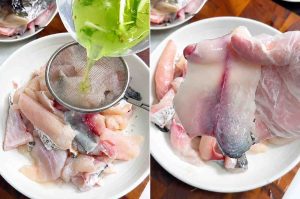
    suancaiyu_Pickled Fish
Prepare the pickled greens, side ingredients and seasonings
  1. Put 250 g pickled mustard greens in a strainer, rinse quickly once, squeeze out the water and cut into pieces about 3 cm long. If the greens are very salty, rinse one more time.
  2. Drain 30 g pickled chili and cut into small pieces.
  3. Slice or shred the remaining 15 g ginger.
  4. Divide 25 g garlic into two portions: 15 g sliced for the broth base and 10 g minced for the final hot-oil finishing.
  5. Cut the remaining 10 g scallion into sections for the broth base, and chop the last 10 g scallion for garnish.
  6. Wash and drain 150 g bean sprouts.
  7. Soak 80 g dried mung bean vermicelli in warm water at 40–50°C (104–122°F) for 10 minutes, then drain. If the noodles are thicker, extend the soaking time according to the package instructions.
  8. Chop 15 g cilantro. Snip 15 g dried red chilies into short pieces and keep 5 g Sichuan peppercorns nearby.
Sear the fish head and bones
  1. Place the wok on the stove and add 20 ml cooking oil.
  2. Heat the oil over medium-high heat; when it reaches about 170°C (338°F), add the fish head and bones.
  3. Sear each side for 3–4 minutes until the surface is golden brown.
  4. Transfer the seared fish head and bones out temporarily. Without a thermometer, look for a flowing sheen on the oil surface and confirm that a small piece of ginger sizzles immediately when added. Do not let the oil keep smoking.
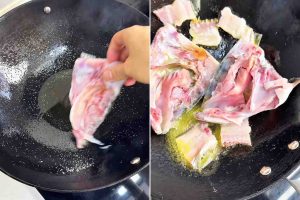
    suancaiyu_Pan-Fried Fish Heads and Fish Bones
Stir-fry the pickled greens and make the broth
  1. Add the remaining 20 ml cooking oil to the same wok and heat over medium heat.
  2. Add 15 g ginger, 15 g sliced garlic and 10 g scallion sections; stir-fry for about 1 minute until clearly fragrant.
  3. Add 30 g pickled chili and 20 g chili paste, and continue stir-frying for about 1 minute.
  4. Add 250 g pickled mustard greens and stir-fry for 3 minutes so the greens and chili paste are well combined.
  5. Add 1000 ml water, then 1 g MSG and 2 g salt.
  6. Return the seared fish head and bones to the wok. Bring to a boil over high heat, then reduce to medium-low and keep at a gentle simmer for about 8–10 minutes.
  7. If the pickled greens are already very salty, add only 1 g salt to the broth, adjusting the total salt for the whole dish to 4 g.
Cook the side ingredients and fish slices
  1. Lift the cooked fish head and bones out with a slotted spoon and place them in a deep dish of at least 2.5 liters.
  2. Add 150 g bean sprouts and the soaked 80 g vermicelli to the broth and cook for another 2–3 minutes, until the noodles are soft and the sprouts have softened slightly.
  3. Lift out the sprouts and noodles with a slotted spoon and arrange them in the deep dish around the fish head and bones.
  4. Add the 600 g marinated fish slices to the wok one piece at a time rather than all at once, so they do not stick together.
  5. Once the broth returns to a gentle simmer, continue cooking for 2–3 minutes. Avoid stirring the fish repeatedly.
  6. Check that the fish is fully cooked: the center of the thickest slice should reach 63°C (145°F). Without a thermometer, confirm the flesh is completely opaque and flakes easily.
  7. Pour the fish slices and broth into the deep dish, spreading the slices evenly over the side ingredients.
Plate and finish with hot oil
  1. Scatter 10 g minced garlic, 15 g dried red chilies and 5 g Sichuan peppercorns evenly over the fish slices.
  2. Heat the last 20 ml cooking oil in a clean small pot over medium heat to about 170–180°C (338–356°F).
  3. Turn off the heat and wait a moment, then pour the hot oil evenly over the garlic, chilies and peppercorns. Pour slowly to avoid splattering.
  4. Finish with 10 g chopped scallion and 15 g cilantro.
  5. Serve hot. If the oil is too hot, the dried chilies will blacken and turn bitter, so do not let the oil keep smoking.
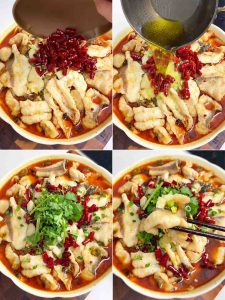
    suancaiyu_Arrange on a plate and stir-fry with hot oil until fragrant

Notes

Ingredient substitutions: Fermented pickled mustard greens are essential to this dish; Sichuan suancai is preferred. If unavailable, an equal weight of fermented pickled cabbage can be used, but the sourness and fermented aroma will differ. If no fermented greens are available at all, buying them online is recommended rather than substituting fresh cabbage with vinegar.
  • Slice the fish into even pieces about 4 mm thick and marinate for 10 minutes before cooking.
  • Pickled greens may already contain a lot of salt. Judge their saltiness before salting the broth; if they are quite salty, reduce the broth salt to 1 g.
  • Do not stir the fish repeatedly once it is in the pot, or the slices will break apart.
  • Cooking time for the fish depends on slice thickness and pot temperature. The center of the thickest slice should reach 63°C (145°F); without a thermometer, confirm the flesh is completely opaque and flakes easily.
  • Use 20 ml oil at about 170–180°C (338–356°F) for the final hot-oil bloom. Oil that is too hot will make the dried chilies bitter.
  • For milder heat, reduce the dried red chilies from 15 g to 5 g.
  • Without a wok, a deep heavy-bottomed skillet can be used; if the pan is shallow, a stockpot of at least 4 liters is recommended.
  • Cook the vermicelli and bean sprouts first, then lift them out and spread them over the bottom of the deep dish. The fish goes in last, which keeps prolonged cooking from changing its texture.