
Homemade chili oil is a very practical and common kitchen condiment in China. Almost every household has its own unique recipe. There are many ways to enjoy it—I like to use chili oil to dress noodles and cold dishes, and I also add a spoonful to cooked dumplings and vegetables. When making it yourself, you can adjust the heat level and choose your favorite spices. For another fragrant homemade noodle dish, try our scallion oil noodles recipe.
My recipe uses coarse chili flakes, fine chili flakes, crushed roasted peanuts, and white sesame seeds. The coarse chili flakes provide a distinct grainy texture, while the fine chili flakes make the chili oil’s consistency more uniform. Green onions, ginger, cilantro, onions, and dried spices are first heated in cooking oil to infuse the oil with their aroma. Next, I pour the hot oil over the chili powder in three separate batches.
Pouring the oil in batches is a key step in the process. After each addition, I stir the chili powder to ensure the oil and chili are thoroughly mixed. Finally, I add a small amount of white vinegar to give the chili oil a hint of tartness. A crisp cold side such as our smashed cucumber salad also pairs well with chili oil.
Coarse chili powder consists of larger pieces of dried chili peppers. Fine chili powder consists of smaller chili particles. The two types differ in size, so when mixed together, they retain both a grainy texture and a uniform red color.
If coarse chili powder isn’t available at your local supermarket, you can use regular dried chili flakes. The particle size of the finished product may vary, but it will still work. If you don’t have fine chili powder, place the dried chili flakes in a dry food processor and pulse briefly to break them down into finer particles. Avoid processing for too long, or the chili flakes will turn into powder, which is more likely to burn when exposed to hot oil.
Before cooking, I always check the ingredients list on the chili powder package. I prefer products without added salt, sugar, or other seasonings, as this makes it easier to control the final flavor.
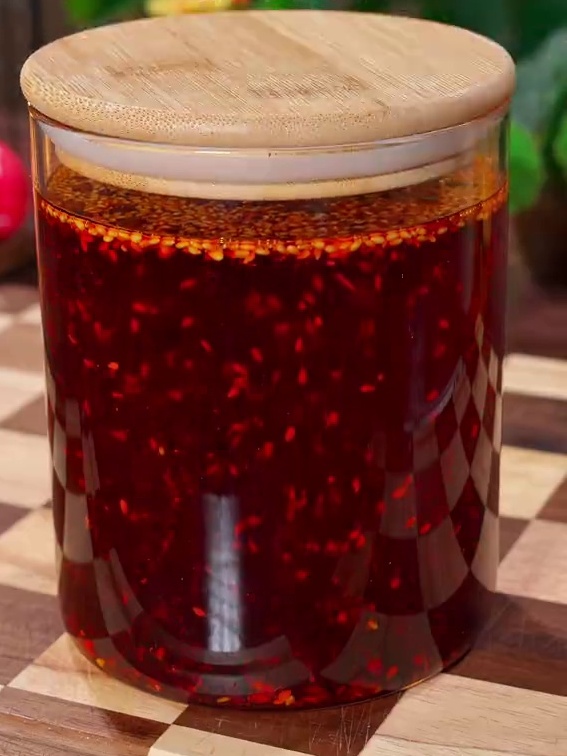
Homemade Chili Oil(la jiao you)
Ingredients
Equipment
Method
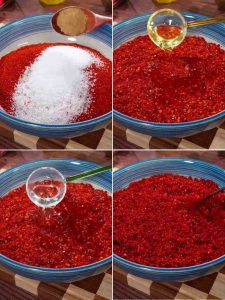
- Place 250 grams of coarse chili powder and 200 grams of fine chili powder in a large, dry, heat-resistant bowl.
- Add 10 grams of white sugar, 10 grams of salt, and 5 grams of five-spice powder, then stir thoroughly until well combined.
- Add 15 milliliters of cooking oil and 15 milliliters of high-proof baijiu, then stir again until there are no noticeable clumps of chili powder.
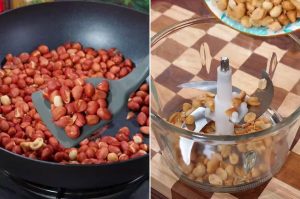
- Place 100 grams of raw peanuts in a dry pan without adding any cooking oil.
- Continue stir-frying over low heat until the peanuts develop light brown spots and give off the aroma of toasted nuts.
- Remove the peanuts and let them cool completely, then rub off the skins.
- Use a food processor to briefly pulse the peanuts, leaving them in small pieces—do not grind them into a powder.
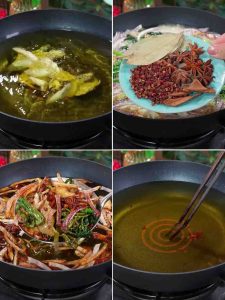
- Pour 1,350 milliliters of neutral cooking oil into a heavy-bottomed pot and heat over medium-low heat until it reaches approximately 150 degrees Celsius.
- Add 100 grams of diced onion, 50 grams of scallion segments, 30 grams of ginger slices, and 30 grams of cilantro, then heat slowly over medium-low heat.
- When the edges of the onions begin to turn golden brown, add 10 grams of cinnamon bark, 10 grams of star anise, 3 grams of bay leaves, and 10 grams of Sichuan peppercorns.
- Continue cooking over medium-low heat until the scallions, onions, and spices turn noticeably golden and release their aroma.
- Use a metal slotted spoon to remove all the spices and vegetable bits, to prevent them from continuing to cook and turning black, which would make them taste bitter.
- First, turn off the heat and use a kitchen thermometer to check the temperature of the spiced oil.
- Maintain the target temperature during oiling at approximately 170 to 180 degrees Celsius.
- If the oil temperature exceeds 180 degrees Celsius, wait for it to cool down before adding more oil. Do not directly convert the traditional measurement of "nine-tenths hot" to 270 degrees Celsius.
- Scoop out a small amount of hot oil from the pan and slowly pour it into the chili powder, stirring constantly with a heat-resistant spoon.
- Make sure the hot oil comes into even contact with the chili powder; avoid pouring the hot oil all in one spot.
- Once the vigorous bubbling subsides, add 15 grams of white sesame seeds and stir until well mixed.
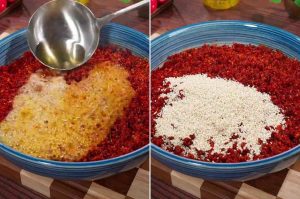
- Once the bubbling has noticeably subsided in the first round, continue adding the hot oil in batches while stirring constantly.
- Add the cooled crushed peanuts and stir thoroughly so that the peanut pieces are evenly distributed throughout the chili oil.
- Examine the color and aroma of the chili powder to ensure there are no charred particles or a noticeable burnt smell.
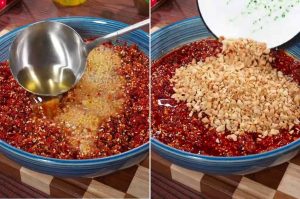
- Pour the remaining hot oil into the chili powder in batches, stirring constantly.
- Once the bubbles have gradually subsided, add 5 milliliters of white vinegar and stir again until well mixed.
- Taste a small amount of the finished product to check the saltiness, acidity, and spiciness.
- Wait for the chili oil to cool completely.
- Transfer the chili oil to a clean, dry glass storage jar.
- Refrigerate immediately and use within 4 days.
- Use a clean, dry spoon each time you take some out to prevent moisture from entering the storage container.
Notes
How can I use homemade chili oil?
I adjust the amount I use based on the dish’s flavor and spiciness.
For noodles: Start by adding 5 to 15 milliliters of chili oil to each bowl of cooked noodles, then add more depending on how spicy you like it.
Dipping sauce for dumplings: Mix 5 milliliters of chili oil with 15 milliliters of soy sauce. If you prefer a tangy flavor, you can add a small amount of white vinegar.
Tossed vegetables: Start with 5 milliliters of chili oil per serving of cooked vegetables, then adjust to taste.
Chili flakes, sesame seeds, and peanuts will settle at the bottom of the chili oil. Gently stir before use to ensure each spoonful contains both oil and ingredients.
Below are some common questions that we hope will help resolve your concerns.
Why isn’t my chili oil red enough?
The variety of chili peppers, the freshness of the chili powder, and the oil temperature all affect the color. Some chili peppers are naturally more orange or reddish-brown and won’t turn the same bright red after preparation. Using fresh, naturally red chili powder and avoiding burning it usually makes it easier to achieve a bright color.
Why does my chili oil taste bitter?
The most common reasons are that the oil temperature was too high, or that the spices and vegetables were fried too long during the simmering process. Fine chili powder burns more easily than coarse chili powder. Next time you make it, try to keep the oil temperature between 170 and 180 degrees Celsius, and remove the spices as soon as they turn golden brown.
Why does the chili oil lack a distinct aroma?
If the spices are heated for too short a time, their aroma may not fully infuse into the oil. If the oil temperature is too low, the aroma of the chili powder may also not be released sufficiently. When simmering the oil, heat the spices slowly; when pouring the hot oil over the chili powder, allow it to produce noticeable but not excessive bubbles.
Can I use just one type of chili powder?
Yes. Using only coarse chili flakes will result in a more pronounced grainy texture in the finished product. Using only fine chili flakes will yield a more uniform chili oil, but fine flakes are more prone to burning. Regardless of which type you use, you’ll need to adjust the oil temperature based on the actual color and dryness of the chili flakes.
How can you determine the oil temperature without a thermometer?
A thermometer is the most reliable option. If you don’t have one, you can test the oil by pouring a small amount over a pinch of chili powder. The right temperature will cause the chili powder to bubble rapidly and release a fragrant aroma. If the chili powder turns black immediately, the oil is too hot. Do not hold your hand near the oil’s surface, and do not test the oil temperature directly with your hand.
Can chili oil be stored in a kitchen cabinet?
This recipe uses fresh spices and vegetables. Even after straining out the solids, homemade chili oil should be refrigerated; long-term storage at room temperature is not recommended. Once refrigerated, it should be consumed within 4 days. If you need to store it longer, portion it out and freeze it. Use a dry, clean spoon each time you serve it.
Can I omit the peanuts?
Yes. Without peanuts, the finished product will have less of a nutty aroma and texture. You can keep 20 grams of white sesame seeds, or you can omit both the peanuts and sesame seeds. Omitting the peanuts will not affect the basic steps of heating the oil and pouring it over the ingredients.