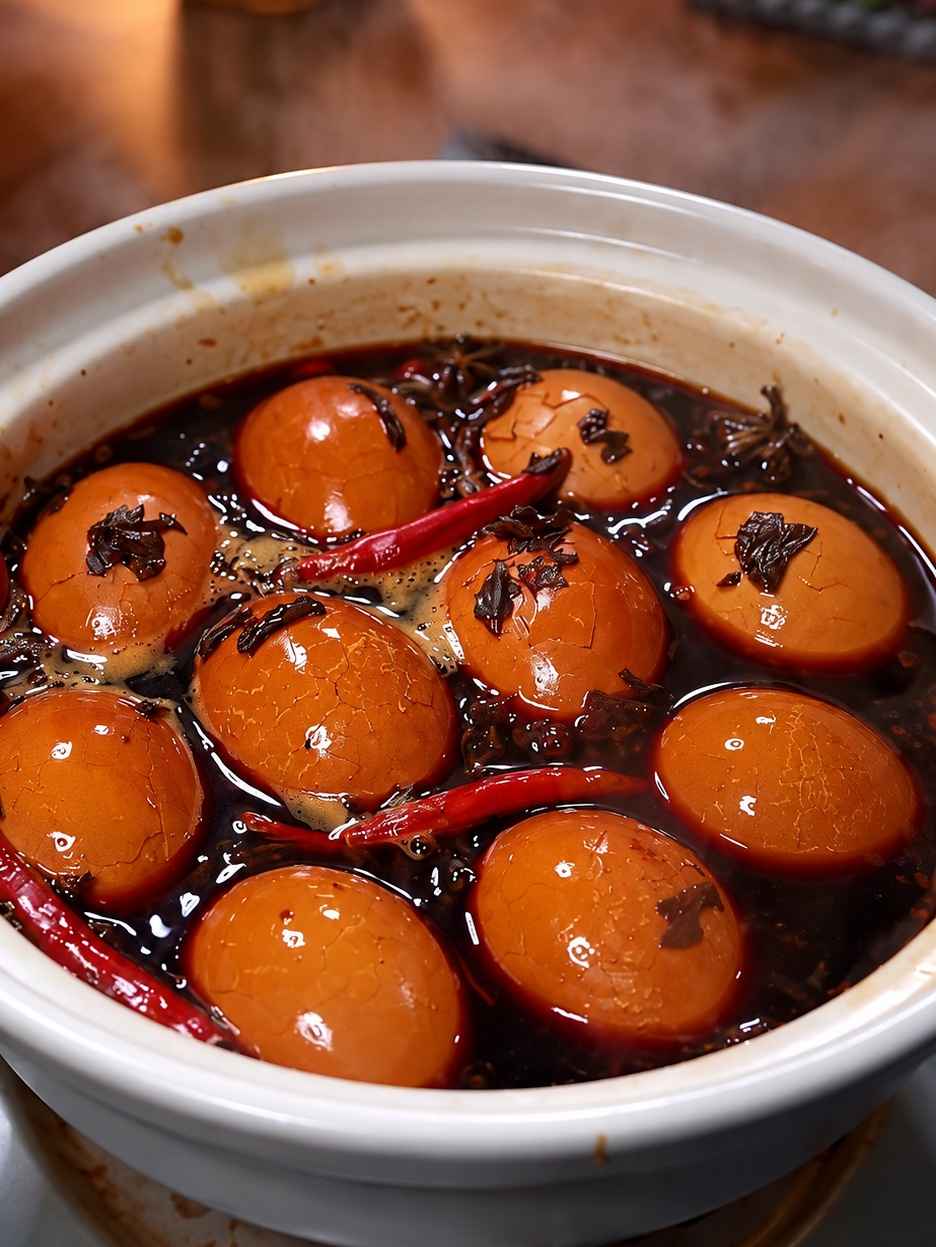
Five-spice tea eggs are eggs that are cooked and seasoned with their shells on. Black tea provides tea aroma and a brown color. Star anise, cassia bark, and bay leaves add aromatic spice flavors. Light soy sauce is mainly used for seasoning, while dark soy sauce is mainly used to deepen the color. Light soy sauce is lighter in color and has a savory, salty flavor. Dark soy sauce is darker and slightly sweeter. For a soft, spoonable egg dish, try our steamed egg custard recipe.
When I make five-spice tea eggs at home, I first boil the eggs until they are cooked. Then I gently tap the shells with the back of a soup spoon to create a network of fine cracks. Next, I add black tea, star anise, cassia bark, bay leaves, scallions, ginger, garlic, and soy sauce. I let the eggs continue cooking in the seasoned liquid so they can absorb the flavors.
Three Small Details I Pay Attention to When Making Tea Eggs
1. Do not make too few or too many cracks in the eggshells. These tea eggs also pair well with a Chinese breakfast favorite such as homemade youtiao.
If the shells have very few cracks, the seasoned liquid has less contact with the egg whites. If the shells break into pieces, the egg whites may protrude through the openings. I gently tap the shells to create evenly distributed cracks. This helps keep the egg whites intact and creates clear, web-like patterns.
2. Black tea and spices serve different purposes.
Black tea mainly provides tea aroma and color. Star anise, cassia bark, and bay leaves add aromatic spice flavors. Dried chili peppers add a little spicy aroma, but they are not essential for making five-spice tea eggs.
3. Do not confuse cooking time with soaking time.
Simmering the eggs for 20 minutes allows the seasoned liquid to release its aromas and come into contact with the eggs. Refrigerating the eggs in the liquid for at least 8 hours extends the contact time between the eggs and the seasoning. These two stages serve different purposes.
For me, the most practical thing about making five-spice tea eggs is that the ingredients are easy to prepare and the process is straightforward. As long as I measure the seasonings accurately, control the cooking time, and let the eggs continue soaking in the liquid under refrigeration, I can make tea eggs at home with a pleasant black tea aroma, fragrant spices, and brown patterns on the egg whites.
Five-Spice Tea Eggs
Ingredients
Equipment
Method
- Rinse the 10 eggs under running water and check that their shells are intact. Do not use raw eggs with cracked shells.
- Prepare a total of 3,000 ml of water. Set aside 1,500 ml for the initial egg-boiling stage and another 1,500 ml for the five-spice cooking liquid.
- Measure out 10 g of black tea, 30 g of scallions, 20 g of fresh ginger, 15 g of garlic, 3 g of star anise, 3 g of cassia bark, 0.5 g of bay leaves, 2 g of dried chili peppers, 15 g of salt, and 25 g of white sugar.
- Measure 45 ml of light soy sauce and 20 ml of dark soy sauce. Prepare a deep pot approximately 22 cm in diameter with a capacity of at least 3 liters, along with 2 shallow heat-resistant containers for cooling and refrigeration.
- Place the 10 eggs in the deep pot and add 1,500 ml of cold water. In a pot approximately 22 cm in diameter, the water should cover the eggs by about 1 cm.
- Heat over medium heat. Once the water reaches a full boil, continue boiling for 8 minutes.
- Remove the eggs with a strainer and rinse them under running cold water for approximately 1 minute, until the shells are no longer hot to the touch.
- Gently tap each egg with the back of a metal soup spoon to create a network of fine cracks across the shell. Do not peel the eggs or break the shells into pieces.
- Discard the water used to boil the eggs. Add the remaining 1,500 ml of water to the clean pot.
- Add 10 g of black tea, 30 g of scallions, 20 g of fresh ginger, 15 g of garlic, 3 g of star anise, 3 g of cassia bark, 0.5 g of bay leaves, 2 g of dried chili peppers, 15 g of salt, 25 g of white sugar, 45 ml of light soy sauce, and 20 ml of dark soy sauce.
- Return the cracked-shell eggs to the pot. In a deep pot approximately 22 cm in diameter, 1,500 ml of seasoned liquid should cover the eggs by about 1 cm. If the pot is too wide, use a narrower, deeper pot rather than adding extra water, which would dilute the flavor.
- Heat the seasoned liquid over medium heat until it reaches a boil, then reduce the heat to low and simmer for 20 minutes.
- Maintain a gentle simmer with small bubbles. Do not let the liquid boil vigorously.
- After cooking, remove the black tea leaves with a fine-mesh strainer. If you used tea bags, remove the bags instead. The star anise, cassia bark, bay leaves, and dried chili peppers can remain in the liquid.
- Turn off the heat and divide the eggs and cooking liquid between 2 clean, shallow, heat-resistant containers. Make sure the eggs are completely submerged in the liquid.
- Place the containers in a larger basin or sink filled with cold water to help the liquid cool quickly. Do not place the entire pot of boiling-hot liquid directly into the refrigerator.
- Refrigerate the eggs and cooking liquid within 2 hours after cooking. Let the eggs soak in the refrigerator for at least 8 hours. Do not leave the eggs soaking at room temperature overnight.
- Peel the eggs before serving. For the best tea aroma and texture, I recommend eating them within 3 days. Refrigerated hard-cooked eggs should be consumed within 7 days.
Notes
Tips and Important Notes
- When cracking the shells, create a network of fine cracks without breaking the shells into pieces or peeling them. The cracks allow the seasoned liquid to come into contact with the egg whites.
- Black tea provides tea aroma and brown color. Star anise, cassia bark, and bay leaves provide the spice aroma. Dried chili peppers can be omitted, but the eggs will have less spicy aroma.
- Light soy sauce is mainly used for seasoning, while dark soy sauce is mainly used to deepen the color. Regular soy sauce can replace light soy sauce. Replacing dark soy sauce may change the color and flavor of the finished eggs.
- The recipe uses 3,000 ml of water in total, divided into two portions of 1,500 ml each. The width of the pot affects the liquid level, so a deep pot approximately 22 cm in diameter is recommended.
- Refrigerate the cooked eggs within 2 hours after cooking. Do not leave the eggs soaking in the seasoned liquid at room temperature overnight.
- Refrigerate the eggs in the cooking liquid for at least 8 hours. Store cooked eggs in the refrigerator for no longer than 7 days. For the best tea aroma and texture, I recommend eating them within 3 days.