Dry-frying is a cooking method in which some moisture is first removed from the surface of the ingredients before they are stir-fried with other ingredients.
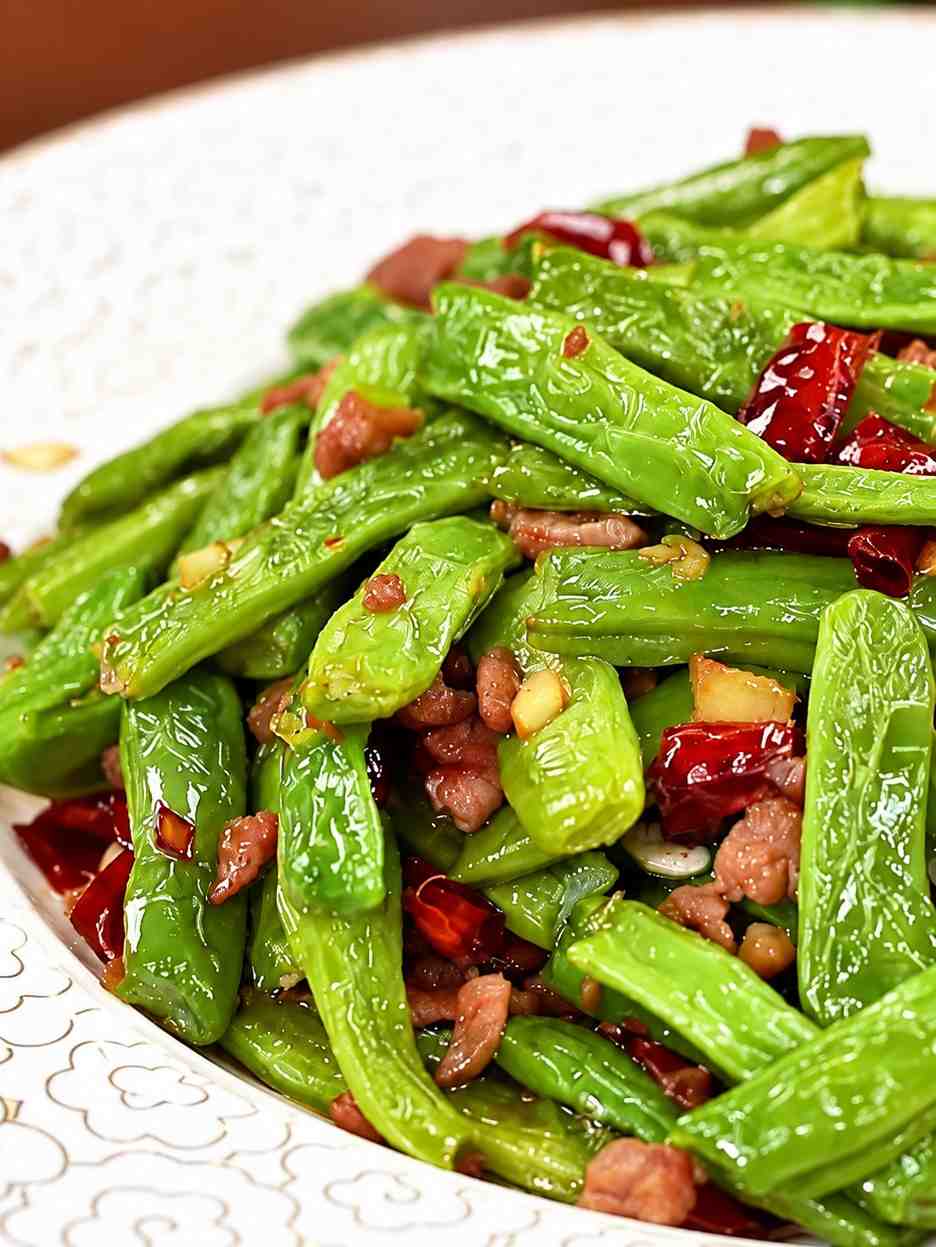
When I make dry-fried green beans at home, I pay close attention to how thoroughly the beans are cooked, the frying oil temperature, and the final seasoning. The green beans need to be cooked thoroughly, and their surfaces should develop slight wrinkles. This helps create a distinctive roasted aroma and allows the minced meat and spices to cling to the beans.
There are a few important things to keep in mind during cooking.
1. Wrinkled surfaces do not necessarily mean the green beans are fully cooked.
The thickness of the beans, the type of cookware, and the actual oil temperature all affect the cooking time. To check whether the beans are done, I look at their surface appearance and check their texture inside.
2. Always dry the surfaces of the green beans before frying.
Water that enters hot oil can cause splattering. I also avoid adding too many green beans to the pan at once.
3. Dried chilies and Sichuan peppercorns need only a short time to release their aroma.
Burnt chilies can develop a bitter taste. I add the chilies after the minced meat is fully cooked and control the heat to reduce the risk of burning them.
Most importantly, the green beans must be cooked thoroughly.
This homemade recipe uses 400 g of green beans and 100 g of minced meat. It serves 2–3 people.
The entire process takes approximately 45 minutes, including 15 minutes for ingredient preparation, 10 minutes for resting the green beans, and 20 minutes of actual cooking.
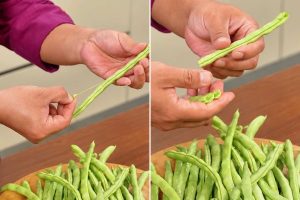
- 400 g Fresh Green Beans Wash the green beans, trim both ends, remove any tough strings, and break them into pieces approximately 5 cm long. Fresh green beans or French beans from a local supermarket can be used. Choose beans with similar thickness so they cook more evenly.
- 100 g Minced Pork Minced pork can be replaced with 100 g of minced beef. Beef has a more pronounced meat flavor. Its fat content depends on the cut, and lean beef may become drier than pork with a balanced amount of fat and lean meat.
- 5 g Salt Use the salt to season the green beans before resting them for 10 minutes. After resting, discard the liquid released by the beans and dry their surfaces. Additional salt is usually unnecessary when seasoning the finished dish.
- 800 ml Vegetable Oil Use the oil for deep-frying the green beans. Canola oil or sunflower oil with a neutral flavor is suitable. Olive oil can also be used, but it will give the finished dish a more noticeable olive aroma. The 800 ml is the amount of oil prepared for frying, not the amount consumed in the finished dish. After frying the beans, remove the excess oil and leave only 15 ml in the pan for stir-frying.
- 2 g Dried Red Chilies Approximately 4 whole chilies, cut into pieces about 1 cm long. If whole dried chilies are unavailable, use 1 g of crushed dried chili instead. Crushed chili releases its heat more quickly and burns more easily. Omit the chilies if you do not want a spicy dish.
- 1 g Sichuan Peppercorns Approximately half a teaspoon. Lightly crush the peppercorns before use. Sichuan peppercorns provide a citrus-like aroma and a distinctive numbing sensation. If they are unavailable locally, you can omit them, but the dish will have less of this aroma and numbing sensation. Black pepper cannot reproduce the characteristic numbing effect of Sichuan peppercorns. Buy Sichuan peppercorns if you want to retain this flavor.
- 10 g Garlic Finely mince the garlic. This is approximately 2 cloves, but use 10 g as the measured quantity.
- 5 g Fresh Ginger Finely mince the ginger. It adds aroma when cooked with the garlic.
- 15 g Scallions Finely chop the scallions. Ordinary fresh scallions from a local supermarket can be used.
- 7.5 ml Huadiao Cooking Wine Huadiao is a type of Chinese rice wine that adds a fermented grain aroma. If it is unavailable, replace it with 7.5 ml of dry white wine or dry sherry. The fermented rice aroma will be less pronounced, while the fruity aroma of the substitute will be more noticeable.
- 10 ml Light Soy Sauce Light soy sauce is a relatively pale Chinese soy sauce used mainly to add salty, savory flavor. If Chinese light soy sauce is unavailable, replace it with 10 ml of regular soy sauce. Regular soy sauce may have a darker color and a stronger salty flavor.
- 2 g White Sugar Use the sugar to balance the overall flavor. Measure 2 g and do not add extra sugar.
1 Deep Wok or 20 cm Deep, Heavy-Bottomed Pot A deep wok with a diameter of at least 28 cm is recommended. Alternatively, use a 20 cm deep, heavy-bottomed pot. A deep, heavy-bottomed pot can replace a wok. A shallow frying pan is not suitable for deep-frying with a large amount of oil.
1 Slotted spoon Use it to remove the fried green beans from the oil and allow excess oil to drain. If you do not have a slotted spoon, use a heat-resistant metal mesh skimmer.
1 Food Thermometer (Optional) Use it to measure the frying oil temperature and the internal temperature of the minced pork. Without a thermometer, you can observe the bubbles around a dry wooden chopstick, but this method cannot accurately measure the temperature.
1 Large Bowl Use it to hold the green beans while salting them. Any other clean, food-safe container can be used instead.
1 Kitchen Knife and Cutting Board Use them to prepare the green beans, scallions, ginger, garlic, and dried chilies. After handling raw minced pork, clean the knife, cutting board, and all surfaces that have come into contact with the raw meat.
4 Sheets of Kitchen Paper Use them to absorb moisture from the surface of the green beans. A clean kitchen towel that does not shed fibers can also be used.
Prepare the Green Beans
Wash 400 g of fresh green beans and remove the surface moisture. Trim both ends and remove any tough strings.
Break the green beans into pieces approximately 5 cm long. Try to keep the pieces similar in length and thickness.
Place the green beans in a large bowl. Add 5 g of salt and toss until evenly coated. Leave the beans to rest for 10 minutes.
After resting, discard the liquid collected at the bottom of the bowl. Use kitchen paper to dry the surfaces of the green beans.
Prepare the Minced Pork and Aromatics
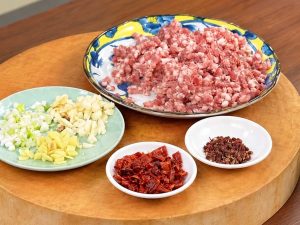
Measure out 100 g of minced pork.
Finely mince 10 g of garlic and 5 g of fresh ginger. Finely chop 15 g of scallions.
Cut 2 g of dried red chilies into pieces approximately 1 cm long. Lightly crush 1 g of Sichuan peppercorns.
Place 7.5 ml of Huadiao cooking wine, 10 ml of light soy sauce, and 2 g of white sugar in a small bowl. Stir to combine and set aside for the final seasoning.
Deep-Fry the Green Beans
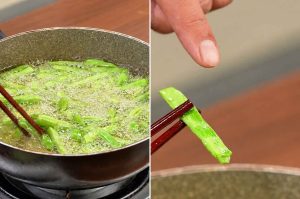
Pour 800 ml of vegetable oil into a deep wok or a deep, heavy-bottomed pot. Heat the oil to approximately 170°C. If you have a food thermometer, use its reading to check the temperature.
Divide the 400 g of green beans into 2 batches of approximately 200 g each. Fry the first batch for about 3 minutes, turn the beans, and continue frying for another 2 minutes.
After approximately 5 minutes of frying per batch, remove the beans with a slotted spoon and allow the excess oil to drain thoroughly. Wait for the oil temperature to return to approximately 170°C before frying the second batch.
Check whether wrinkles have formed on the surfaces of the beans and whether the insides are tender. If the beans are particularly thick or remain firm inside, continue frying for another 1–2 minutes until fully cooked.
Stir-Fry the Minced Pork and Aromatics
After frying the green beans, use heat-resistant utensils to remove the excess oil. Leave only 15 ml of vegetable oil in the pan.
Keep the pan over medium heat. Add 100 g of minced pork and break it into small pieces with a spatula. Stir-fry for 3–4 minutes until the pork changes color throughout and no obvious pink, raw-looking meat remains.
Once the minced pork is cooked, add 2 g of dried red chilies and 1 g of Sichuan peppercorns. Stir-fry over medium-low heat for 20–30 seconds.
Add 10 g of minced garlic, 5 g of minced ginger, and 15 g of chopped scallions. Continue stir-frying for about 30 seconds. Do not allow the garlic or dried chilies to burn.
Season and Finish the Dish
Pour the prepared mixture of 7.5 ml of Huadiao cooking wine, 10 ml of light soy sauce, and 2 g of white sugar around the sides of the pan.
Stir-fry for about 20 seconds so the minced pork and aromatics are evenly coated with the seasonings.
Return all the fried green beans to the pan. Stir-fry for another 1–2 minutes until the beans are evenly coated with the minced pork and seasonings.
Check that the green beans are fully cooked. If the insides remain firm, continue cooking before serving. Since 5 g of salt was already used to prepare the beans, additional salt is usually unnecessary.
Doneness: Green beans must be thoroughly cooked. Do not judge doneness only by surface wrinkles or color. The Centre for Food Safety in Hong Kong warns that raw or insufficiently cooked green beans may pose a food safety risk.
Oil temperature: Keep the frying oil at approximately 170°C. Divide the green beans into 2 batches of approximately 200 g each. Fry each batch for 3 minutes, then continue frying for another 2 minutes. If the insides remain firm, fry for another 1–2 minutes.
Preventing oil splashes: Dry the surfaces of the green beans before frying. Do not add all the beans at once, and do not allow water droplets to enter the hot oil.
Controlling the amount of oil: Prepare 800 ml of oil for frying. After frying the beans, remove the excess oil and leave only 15 ml in the pan for stir-frying the minced pork. Use heat-resistant utensils when handling hot oil, and avoid lifting a pan containing a large amount of hot oil.
Ingredient substitutions: Huadiao cooking wine can be replaced with 7.5 ml of dry white wine or dry sherry, although the fermented rice aroma will be less pronounced. Light soy sauce can be replaced with 10 ml of regular soy sauce, which may produce a darker color and a saltier flavor. Sichuan peppercorns can be omitted, but the dish will have less of their characteristic numbing sensation and aroma.
Minced pork doneness: Cook the minced pork thoroughly until its color changes throughout. If you have a food thermometer, check that the internal temperature reaches at least 75°C.